Medill-Northwestern Journalism Institute
The “Cupid Shuffle” blares from a speaker along Central Street as dozens of cheerleaders prepare to march. Spectators and participants eagerly count down until the 2 p.m. start time. Across the street, people around the Evanston Roundtable parade car discuss the “Big, Beautiful Bill.”
Seeing the U.S. flag and wearing red, white and blue carried different meanings for parade goers this year.
Claire Zulkey, the Evanston Roundtable’s “Raising Evanston” newsletter editor, said people who aren’t MAGA supporters need to reclaim the concept of patriotism. Expressions of national allegiance are commonly associated with the right, but Zulkey said the left needs to redefine it for themselves, too.
“It’s pretty irritating to imply that if you are not MAGA, that you don’t also care about America, and that you’re not allowed to [fly] the flag,” she said.
Frank Herman — a 19-year-old who carried a huge U.S. flag as he walked with a group supporting Democratic congressional candidate Kat Abughazaleh — said being patriotic reflects his American identity, not his political party.
“You got to show enthusiasm and love for your country, even and especially when you don’t love the government,” he said. “Anybody who loves their country always wants it to change.”
U.S. flags lined the parade route. They hung from lamps, waved in the hands of parade goers on the street and sidewalks and even blew in the breeze under the Ryan Field construction. To some, like Herman, the flags represented hope for the U.S. For others, the flags were a sign of solidarity.
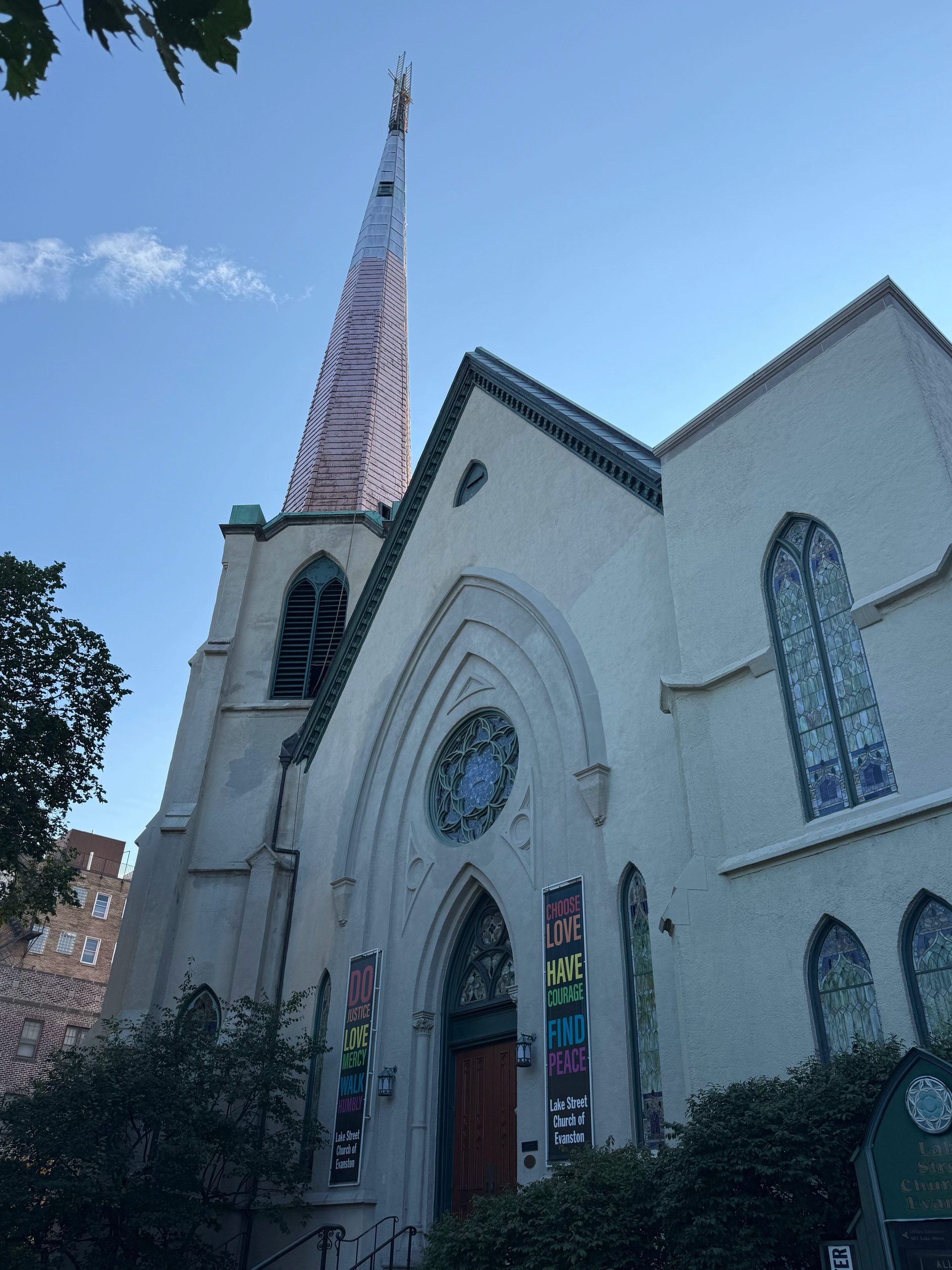
“I think everybody should fly a flag today, because it doesn’t just belong to one side,” said Chris Walker, a 71-year-old Evanston resident who was marching with other Lake Street Church members. “And the more people who fly it, the more we have in common.”
To Walker, flying the flag is just one form of expressing patriotism that “builds momentum and a sense of community.” Kathy Hayes, president of the Democratic Party of Evanston, also conveyed her desire for unity. She said her main goal as president is to end division among neighbors.
“Patriotism is a tricky word,” Hayes said. “I’m more interested in us coming back as a healed community.”
Part of Hayes’ complex perception of the word stems from her race. As a Black American, Hayes said she and her community were often excluded from historic patriotic movements, so the word doesn’t evoke the same nationalist feelings.
Hayes isn’t the only one who struggled to find allegiance on the Fourth of July. Others associated pride with Evanston but said it’s missing on a national scale.
“On a local level, patriotism and community are important,” said Javi Barrio, an Evanston parent. “On a macro international level, what patriotism might mean is subjective.”
To exemplify his point, he looked to the Windy City Miata Club coming down the street. The Mazda MX-5 Miata was originally only offered in red, white or blue, leading many to perceive the car as a patriotic symbol. Though the Miata was designed in California, it is manufactured in Hiroshima, Japan, Barrio said, calling it a “contradiction in and of itself.”
While Barrio used the Miata to exemplify patriotism’s convoluted nature, Robert Plocar, president of the Miata Club, had a more straightforward view. He used his decorated car to show the unifying power of patriotism.
The word evokes “a nice understanding of other people and trying to get people to come together,” Plocar said.
Amid sharp political division, Hayes acknowledged the challenges of national allegiance but said she’s looking for its benefits. Celebrating collective pride presents a unique opportunity for the community to unite, she said.
Patriotism isn’t all “apple pie and ice cream,” Hayes said, “but it is a possibility for us to be neighbors, for us to be relatives and friends, and for us to be a part of each other’s lives in a constructive way.”