
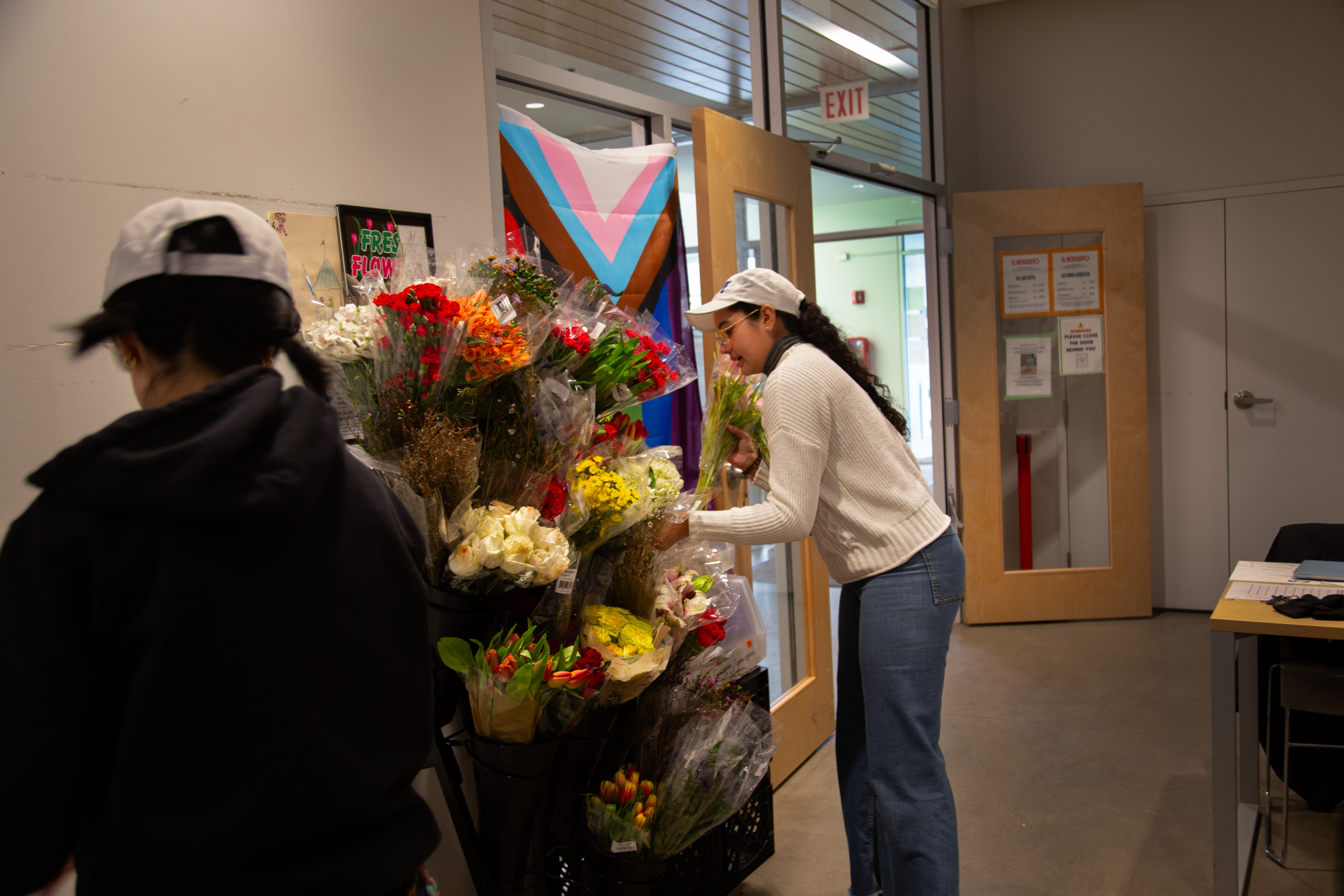
Laura Salgado showed up for her volunteer shift at one of Nourishing Hope’s Chicago food pantries expecting to be put to work moving frozen meals and wheeling carts of groceries. She did not expect to hand out flowers. However, seeing customers’ reactions to the florals showed Salgado exactly what “nourishing hope” can look like. She heard one parent exclaim that now they had flowers for their daughter and watched as another customer eagerly took a bouquet to give to their mother.
For the last few months, Salgado has been visiting nonprofit organizations like Nourishing Hope to create promotional content as the External Communications Director of Northwestern’s Cause Marketing Initiative (CMI). Nourishing Hope is a hunger relief nonprofit that provides resources for food, mental wellness and social services across Chicago.
Each spring, CMI takes on 15-20 nonprofits in the Chicago area and provides them with pro bono marketing services. CMI is run entirely by graduate students, like Salgado, in Medill’s Integrated Marketing Communications (IMC) program who leverage their skills to develop and implement everything from brand strategy to stakeholder analysis to public and media relations. They work with organizations that, despite their essential role in the community, are often underfunded and lack adequate resources to expand their reach.
According to the 2024 Nonprofit Marketing Trends Report, most nonprofits only have one or two staff members devoted to communications. 71.9% of surveyed nonprofits identified limited budgets and resources as a challenge they foresaw in achieving marketing goals, according to Feathr, a nonprofit digital marketing service. Research by Tapp Network and TechSoup consultants found that less than half of nonprofits have a digital marketing strategy in place.
That’s where CMI comes in. In January, the student executive board reaches out to local nonprofits with information about the program and a “Request for Proposal” through which the organizations can detail their marketing goals.
The program has grown from seven or eight clients in 2008 to 20 in 2025; about one-third of the projects return year after year. This cycle, interest was so high that CMI had to turn down a few projects. Advisor Chris Cahill, an IMC faculty member, says it’s a metric of the program’s success.
“I look at the number of clients that come back that next year and want to continue working with CMI,” he says. “I see that as a way to measure the value they’re deriving from these projects and working with the students.”
The board then matches four or five-person student teams with nonprofits. IMC students rank their choices based on how the organizations’ missions resonate with them and how the desired project aligns with their goals and experience.
Once the board has finalized the project and teams, they host a kickoff event where organizations get to meet the students they’ll be working with and start building a network with other nonprofits in the area.
“It’s really one thing to communicate with organizations over email,” IMC graduate student and Program Director Jimmy He says. “But to put a face to these organizations and see how excited these nonprofits are to be working with students, even though we’re just students… to see us grow and help us help them was really rewarding for me.”
Because the IMC program is only 15 months long, the students in CMI turn over every year. This year, over 85 students are participating in it — about 60% of the IMC cohort. Cahill says the high level of involvement shows how eager students are to work with nonprofits.
For many, the work allows them to feel engaged with their community. He saw CMI as a way to give back to the neighborhood that had contributed so positively to his undergraduate experience at Northwestern. Salgado wrote about her interest in CMI as part of her IMC application. Mallika Mehta, team leader for one of the program’s projects and an international student from Delhi, India, hoped the experience would help her acclimate to her new city.
“[CMI] shows direct impact to see if the skills we’re trying to gain from the program are being used or are being applied well,” Mehta says. “It was one of the most meaningful ways I could learn to become a marketer, but it was also a lot about becoming a responsible part of the community I’ve just joined.”
Mehta’s team is doing a brand management project with Ten Thousand Villages, a fair trade retailer in Evanston. Their goal is to better reach their target audience and raise consumers’ awareness of Ten Thousand Villages’ unique mission to ensure their artisans are paid a livable wage, support traditional cultural arts and work with marginalized communities.
Ten Thousand Villages thought it was a good time to embark on a marketing collaboration because they recently moved business districts — Main-Dempster to Downtown Evanston — and wanted to increase outreach in their new neighborhood.
“Some of my team members are coming to IMC straight from undergrad, so it was quite interesting to see how they have developed their leadership, their client communication skills and also figure out the right balance between business objectives and nonprofit missions,” Mehta says.
The CMI students consulting for Ballet Chicago are working to increase the company’s engagement with a target audience — in this case, a younger demographic. They’re hoping to build the ballet company’s social media presence with behind-the-scenes and day-in-the-life of a dancer segments.
Emily Hsueh, the team leader for the CMI group working with Ballet Chicago, says she has loved watching their plans come to life on the organization’s Instagram stories and website.
“Being able to do our work and then put it into the real world is fantastic,” Hsueh says.
To ensure a successful project, teams break up their goals into specific deliverables scheduled across the span of the program, adjusting their objectives as needed based on routine communication with their clients. On May 30, the student teams and nonprofits will come together for a wrap-up party where teams have the opportunity to present the strategies and plans they’ve developed and any results they’ve seen.
To evaluate which strategies are yielding results, the Ballet Chicago team pays attention to click-through rates with ticket links on the company’s website, marketing emails and Instagram. Sharyn Pulling, Ballet Chicago’s general manager, says their ticket sales are higher this year than last and that they are on track to exceed their current sales goals.
“[Marketing] is a challenge for small businesses,” says Hannah Wymer, the store manager at Ten Thousand Villages. “We wear a lot of hats, and it’s a few people doing all the things.”
In addition to implementing the conceptual skills students develop in the classroom, the projects are an opportunity to practice problem-solving. Nonprofits’ small and busy staff, the short 12-week timeline and budget constraints require teams to stay flexible and creative.
“[CMI] teaches you to communicate with empathy. You are not just selling products or services anymore. You’re trying to inspire action,” Mehta says. “As a team, we have learned how to stretch our emotional intelligence and think beyond business, think about how our marketing initiatives can help the community at large.”
Designed by Chase Engstrom.