
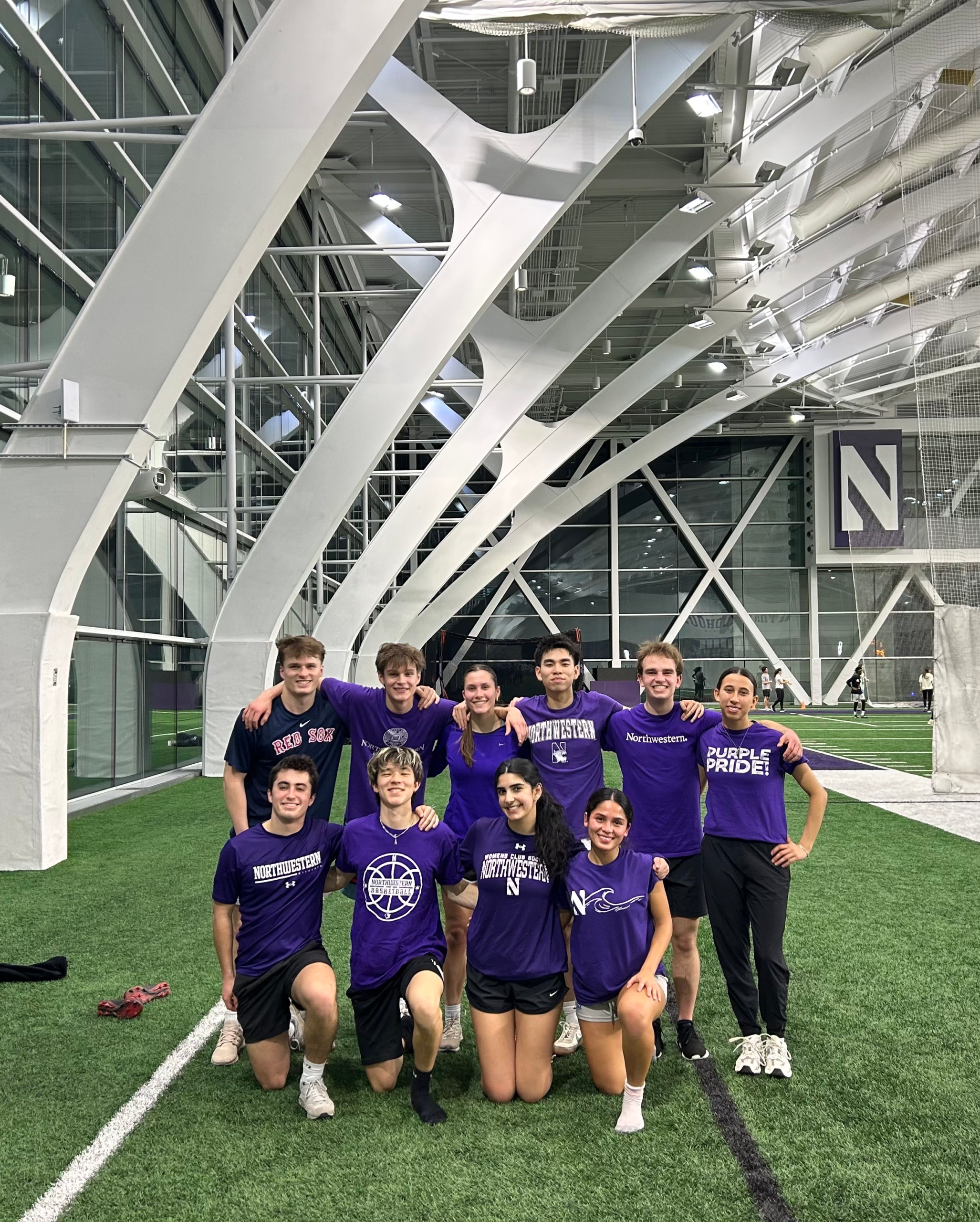
Tillie Freed was recruited to the competitive division of winter intramural (IM) soccer by a member of the pickup soccer league she played in on campus. The Medill first-year was initially confused by the request.
“I play fine at pickup but I’m not doing anything crazy, so I was like, ‘Why does he want me to play on his team?’” Freed says. “Then I asked, ‘Is there a gender requirement?’ and that’s how I figured it out.”
Every Tuesday night of Winter Quarter, students file into the Henry Crown Sports Pavilion (SPAC) and make their way up to Ryan Fieldhouse. Typically, the Fieldhouse is filled with NCAA and club athletes, but once a week, it opens up to a different group of students: IM soccer players.
These indoor 5v5 IM soccer games provide a unique opportunity for men and women to compete together — similar to the outdoor spring 11v11 IM soccer season that kicked off in early April. Using Northwestern’s online IM sports portal, students can sign up by adding friends to their rosters and selecting a time slot to play in either the competitive or recreational league, based on skill level.
However, the winter season has one major rule difference: a gender requirement.
Compared to the “open” spring league, which has no restrictions on who can join, the winter league is COREC, meaning teams must consist of both men and women. The official IM handbook requires each team to have a minimum of two women on the field at all times, a rule that has been in place ever since winter IM soccer was introduced about four years ago, according to Northwestern’s director of IM sports Ryan Coleman.
The rule is designed to foster a more inclusive and fair playing environment. This year, many female players noted that, though well-intentioned, the rule is not effectively encouraging women to participate. Rather, many are brought to IM soccer for the purpose of filling a quota.
Weinberg first-year Rosa Saavedra was recruited by male players looking to fulfill the gender requirement. While getting lunch at Sargent Dining Commons, she overheard the students next to her talking about the soccer video game FIFA, and inserted herself by arguing about formations.
The male students were impressed by her knowledge of FIFA and soccer in general, Saavedra says, and immediately asked her to join their team. Saavedra hadn’t heard of the IM program before, but as a former captain of her high school’s varsity soccer team, she was intrigued by the opportunity.
“I looked at [my friend], and I was like, ‘I’ll only do it if she does it.’” Saavedra says. “I didn’t think she was going to, but then she was like, ‘We’ll both do it!’”
Once on the field, Saavedra and other players noticed a lack of women in the program. If a team can’t fulfill the two-woman requirement, they are forced to compete with fewer players. If just two women show up, they must play the whole game with no substitutions and can experience overexertion.
Female players are in high demand during the winter season.
“Honestly, it was the most wanted I’ve ever felt in my life,” Freed says. “I had so many people ask me to play with them.”
Similarly, McCormick third-year and women’s club soccer captain Nicky Williams, who has played IM soccer since her freshman year, says she has gotten a text “every weekend” for the past three seasons asking if she can play in a game.
Some players, such as Medill first-year Natalie Gordon, enjoy the extra playing time. But there are times when she feels it inevitably hinders her performance level.
“I think it did get tiring at some points, which posed a challenge,” Gordon says.“I don’t want to be bringing the team down because of this rule.”
Despite the lack of female players, many believe the rule is a necessary component of the coed league. Many female players say they would not have been introduced to IM soccer if it were not for the gender requirement.
“It is kind of unfortunate, but that is the truth,” Weinberg first-year Jordan Stuecken says. “I am really glad that I did IM soccer, but I feel like if they didn’t have that rule they probably just would have formed a team from the guys they know.”
Just like Freed and Saavedra, Stuecken wasn’t initially planning on playing but joined after receiving a text from a male friend inviting her.
Freed also says she began to question the intention behind the encouragement expressed to her and other female players.
“Obviously they need me, so they have to be nice to me to some extent,” she says. “There is some sort of transactional-ness to it.”
Coleman agrees that without the gender requirement, there would be significantly fewer women participating. For example, there is currently no gender rule in the spring outdoor season, and because of this the league is “essentially a men’s league,” Coleman says.
The idea of playing on, literally, a male-dominated field can be off-putting for many female players.
“There’s obviously a strong biological difference; I’m not going to be able to beat them in a foot race,” says Willams. “I think it’s hard because a lot of the girls are just intimidated when they are going up against guys who are really good.”
For Stuecken, the idea of going up against experienced male players was intimidating. Prior to the winter season, she had not played soccer since her senior season in high school and was hesitant to join IM.
Ultimately, she decided to step out of her comfort zone on the condition that she would have one of her friends playing by her side. Stuecken found that as the season progressed, she got more comfortable in the playing environment.
Looking to the future, many players believe that there are ways to make the IM program more encouraging for female students. Williams says an all women’s league or stronger rules against slide tackling could make the environment more welcoming.
Stuecken notes that having more female referees would contribute to a more positive environment. In fact, she does not recall having a single female referee throughout the season.
Some of these approaches have been tested in the past. Coleman has worked as the IM director since 2001, and has attempted to create women’s leagues across various sports several times. According to him, not enough people sign up.
Coleman says since more female players show up to the COREC league, that’s what the program pursues.
“I do my best, because we don’t have women’s leagues, to create a more positive environment for women in those leagues,” Coleman says. “Like for basketball, it’s three women on the court. Most schools around the country, it’s two. And I thought, ‘now we don’t run a women’s league, so I want there to be more women on the court.’”
Coleman is constantly checking in with his staff of student officials and supervisors to make improvements to the program. This means the gender rule could change or more rules could be implemented at any time.
Coleman also points out Northwestern’s IM program is twice the size of some state school programs in the Midwest. According to Coleman, having solely COREC leagues in the winter instead of “open leagues,” or ones where there is no gender requirement, somewhat mitigates this problem. If there were only open leagues, he predicts he would receive up to 150 teams attempting to register, composed of mostly males.
With Northwestern’s strong soccer community, the lack of female players does not seem to overshadow positive experiences with IM soccer. For some, nights on the turf are some of the most memorable moments of college.
Saavedra reflects on the moment when her team — the “Ball Busters” — finally secured their first win from the last game of the season.
“You would have thought we won the World Cup,” she says. “Moments like that remind me of when I played club soccer competitively and how much I miss it.”
Despite the skewed gender ratio, female participation seems to be trending in a positive direction. Williams notes there has already been a large increase in the number of women since she started playing three years ago. That said, there is always room for improvement.
“Being part of a team is such a valuable experience,” Freed says. “I would like more girls to be able to experience that.”
Print design by Sarah Jacobs.