
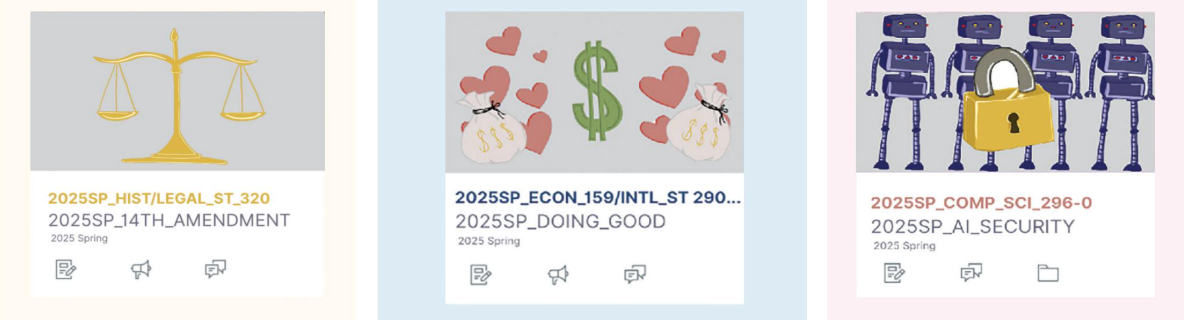
Students anxiously refresh CAESAR as the seconds tick down to their course registration time. They try enrolling in their top choices, only to find courses which were open seconds ago are now completely filled. This is a scene that plays out every quarter. While many of Northwestern’s classes cover subjects that prepare students for their future careers, some of them focus on important issues relevant to students’ day-to-day lives or current events. With the flurry of executive orders and policy changes from President Donald Trump’s second administration, subjects ranging from international economic policy to immigration and artificial intelligence have moved to the forefront of many students’ minds. North by Northwestern explores three classes that center current and relevant topics.
HIST/LEGAL ST 320: The Fourteenth Amendment
The Fourteenth Amendment to the Constitution guarantees rights such as birthright citizenship and equal protection under the law. This course offers students an in-depth look into the 1868 amendment and how the Supreme Court has interpreted its meaning, both expanding and limiting the rights it delineates. Students also study how social movements have shaped the amendment’s significance.
While many recent headlines are concerned with Fourteenth Amendment protections, this subject matter is always pertinent, says associate professor of instruction of Legal Studies Joanna Grisinger, who co-teaches the course with professor of History Kate Masur.
“I really want students to feel like, when they read the materials, when they’re reading the sources, that they can understand this too,” Grisinger says. “And that they can keep up with current debates, and that they have a role to play in current debates.”
ECON 159/INTL ST 290: Doing Good
Why do people do good? The answer to this question is explored in a quarter-long journey through psychology, philosophy and economics in this intro-level class. Students in the class learn about different ways to evaluate impact and success so they can assess the effectiveness of real-world charities and nonprofits.
As the Trump administration makes cuts to U.S. foreign aid, “Doing Good” explores how people use available resources and information to decide on charities to support. Throughout the quarter, the class will narrow down a list of 32 charities to one that will receive a $20,000 donation, putting what they learn to good use.
Dean Karlan, Frederic Esser Nemmers Chair in Economics and Finance and the former chief economist for the U.S. Agency for International Development (USAID), taught an upper-level version of this class in previous years. However, he says he wanted to create a class that was open to students with a variety of academic backgrounds and combined economics with ideas from psychology and philosophy.
“When you put them all together, they do end up providing some guiding lights for how to think about what charities are particularly effective or what we can do with our volunteer time.” Karlan says.
COMP SCI 296: AI and International Security
While many Northwestern students may use ChatGPT to help them answer a math question or explain a complicated topic, the reach of artificial intelligence isn’t limited to academics. This class explores the role of AI in international security: how it can be used to protect against cybercrime, but also how it can be used by cybercriminals. This is only the second year the class is being offered, and it is open to all students.
McCormick second-year Brock Brown is taking the class to satisfy an elective requirement for his major and because of his general interest in AI and machine learning.
“I just wanted a firmer grasp on how everything is connected and what we could potentially do in the future to … make sure people don’t use [AI] in bad ways,” Brown says.
Print design by Sarah Brown.