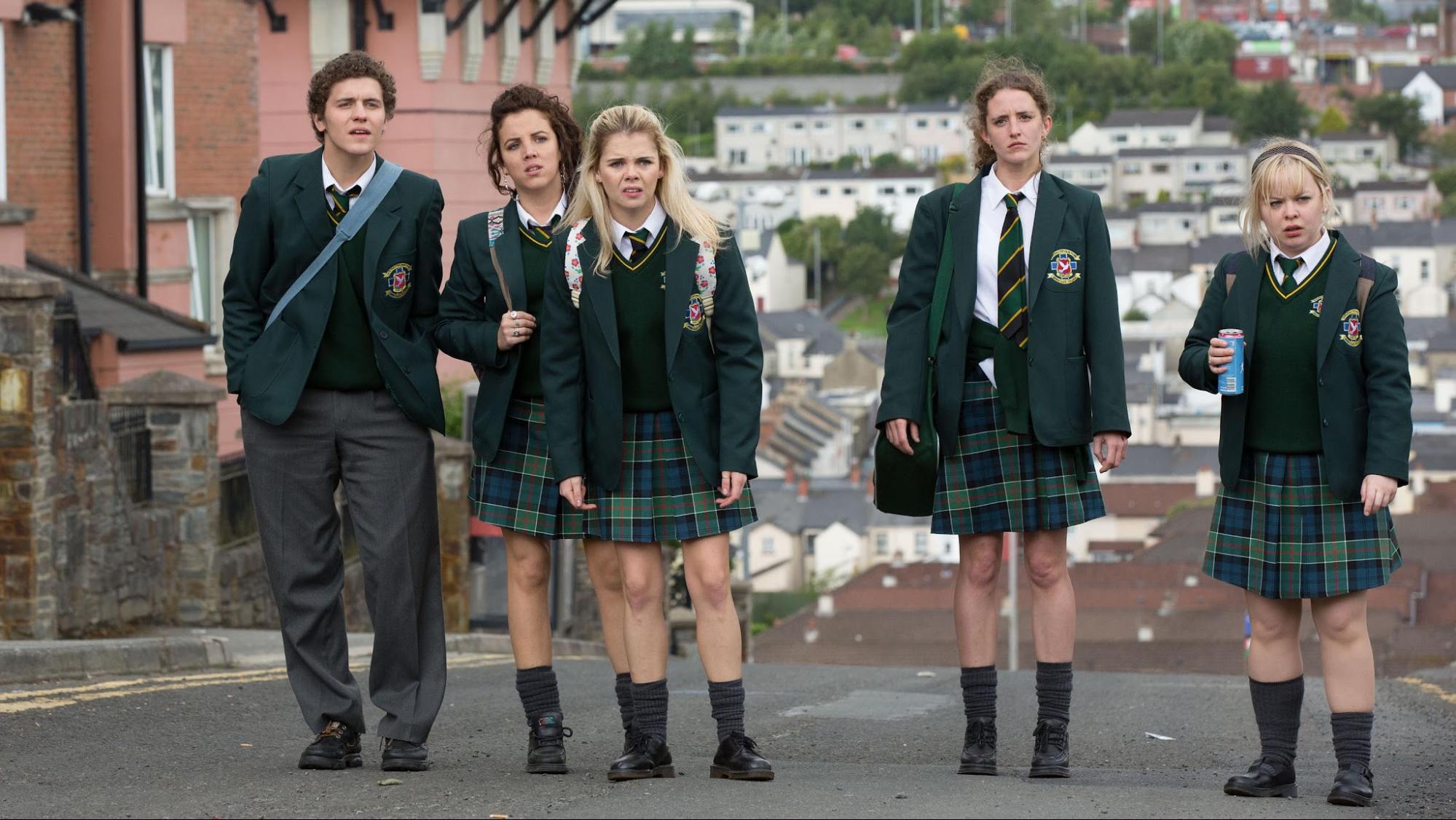
“Imagine being born there and not here, we don’t know how lucky we are,” says Clare Devlin (Nicola Coughlan).
“Aye, fair dues. Derry has class,” replies Michelle Mallon (Jamie-Lee O’Donnell). It’s the start of just another typical school year for the Irish teenagers. Moments later, their school bus is boarded by two machine-gun-wielding soldiers, interrupting the group’s menial conversation.
Yet, none of the girls react. Well, maybe Michelle does say, “Some of them are rides. I’m willing to admit it even if no one else will.”
In the mid-1990s, Northern Ireland continued to face the Troubles, a period of tense political conflict between Irish Catholics and English Protestants over whether the region should break from the United Kingdom to join the Republic of Ireland. With many bombings, shootings, assassinations and riots, Northern Ireland appeared to outsiders as a nightmare – a place defined by decades of violence.
Amongst all this violence sit five quirky teenagers living in the small Northern Irish town of Derry, where the Troubles are simply part of growing up. The background noise of paramilitary groups and guerrilla warfare veils the concert tickets to secure, drinks to sneak onto school trips and priests’ hairstyles to admire.
What makes Derry Girls essential is not just its wildly hilarious dialogue or the unmistakable accents that deliver it, but rather its heartwarming portrayal of how the chaos of ordinary teenage life still takes precedence over the political violence that surrounds it.
Regardless of your taste in humor, you can find it in Derry Girls. From deadpan absurdity to ironic misunderstandings, with swaths of vulgar jokes in between, this show has it all.
Each of the five main characters, Erin Quinn (Saoirse-Monica Jackson), Orla McCool (Louisa Harland), Clare Devlin, Michelle Mallon, and James Maguire (Dylan Llewellyn), has their own unique comedic style. Erin’s dramatic self-centering turns minor inconveniences into personal tragedies, while her cousin Orla remains blissfully aloof, making casually bizarre comments like “So lesbians really do exist.” There’s Claire’s amusingly extravagant anxiety, often born from Michelle’s rebellious recklessness that regularly puts the group in awkward situations. And finally, there’s James, the sitcom’s classic “fish-out-of-water,” and Michelle’s awkward English cousin, forced to attend her all-girls Catholic school out of fear for his safety at the local boys’ school.
Despite the absence of physical violence in the girls’ school, James cannot escape the Irish nationalist resentment toward British occupation. As the only Englishman surrounded by Irish Catholics, James is naturally teased for his nationality, though primarily by his Irish cousin Michelle. Though instinctive, sarcastic banter is really Michelle’s love language, it still shows audiences how generations of conflict and resentment toward British rule shape even the most ordinary interactions among friends.
Even with such distinct personalities, there are few television friend groups whose chemistry rivals this one’s. With overlapping conversations, rapidly escalating conflicts and a constant barrage of loud, messy interactions, the show never loses its authenticity. It rarely relies on the structured punchlines of classic sitcoms. Instead, the humor stems from perfectly timed side-eye glances and absurd misunderstandings that spiral naturally out of the characters’ dynamics.
Though the harsh realities of the Troubles, from the constant presence of armed soldiers to frequent bombings and sectarian violence, may paint Derry as a war-torn, dangerous city, the historical events that surround them often do not faze the teenagers and their families. When a bomb threat shuts down a local bridge, the characters have little concern for the potential danger; Orla’s mother simply complains that it will make her late for her tanning appointment.
By finding humor within chaotic lives, Derry Girls provides audiences with a breath of fresh air in anxious times. We’ve all watched countless coming-of-age stories, but very few capture what it means to grow up in an incredibly divided world that’s defined by intense political conflict. For present-day viewers, this political division is nothing new. We’ve witnessed the growing polarization of politics, the increase in political violence and most disturbingly, the threat of gun violence in schools.
However, similarly to the Derrians, life goes on. The show reminds us of the importance of holding on to humor and normalcy, rather than living in an all-consuming state of perpetual conflict. Derry Girls reminds us that adolescence is as much about learning to navigate the complicated realities of adulthood as it is about finding moments of joy in the little things.
The characters’ insecurities, embarrassments, anxieties and friendships are universally resonant and encapsulate the timeless experience of growing up. Everyone can picture their teenage self within at least one of the show’s characters — even if you were never an Irish Catholic schoolgirl. That familiarity draws you in, but the genuine care you’ll feel for these characters, especially when the reality of conflict kicks in, is what keeps you watching.
The first season’s finale ends with one of the most effective scenes in television. At school, the group rushes on stage to join Orla’s awkward — but kind of really good — performance of a stepdance routine, attempting to save her the embarrassment of performing it alone. Just as they arrive, the show cuts to the girls’ families gathering around the television, as they learn news of a bombing that killed several civilians. The infamous Cranberries’ song, “Dreams,” plays in the background of the news coverage, as the show departs from its typical, trivial comedy to remind us of the town’s painfully tragic reality.
Even still, as the Cranberries repeat “my life is changing every day,” the girls continue to awkwardly dance onstage, blissfully unaware of the violence for the time being. Beneath the bombings and the checkpoints and the soldiers with machine guns on school buses, there are still five normal teenagers just trying to find their place in the world. We all know what it’s like to feel like an outsider, to stress over rumors and exams, to desperately want to seem intellectual and mature. It’s so easy to recognize our own teenage insecurities in the characters’ awkward attempts to fit in, impress their classmates, and figure out the person they want to be.
After all, just as James loudly proclaims in the season two finale, anyone can be “a Derry Girl.”