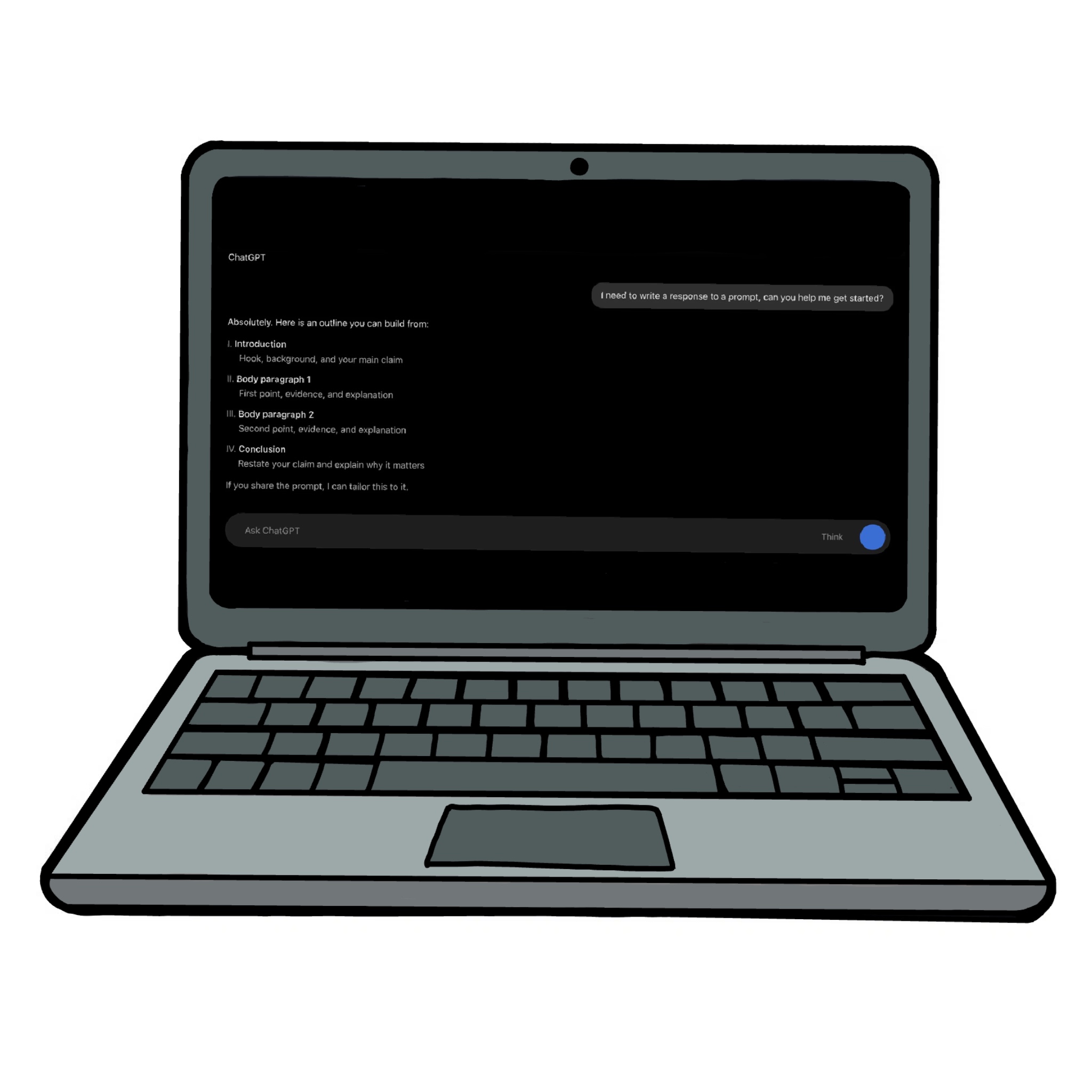
With artificial intelligence (AI) making big breaks in education over the last few years, Northwestern educators and students alike are beginning to integrate it into their own academic practices. As professors’ policies vary classroom-to-classroom and students have differing thoughts on its use, both similarly express a mix of concern and optimism about its role in the classroom and in careers.
Students and educators worry that AI could devalue their work and reduce individual efficiency. Despite this, people from both groups hope the technology can be used to augment their work rather than replace it.
Kristian Hammond, the Director of Northwestern’s Master of Science in Artificial Intelligence Program, finds an integral emotional aspect in people’s adversity to AI. Hammond said that realizing that human work can be done by machines can be a hard conclusion to come to, but should be embraced nonetheless in order to scale natural ability and skill.
He also says it would be “irresponsible” for academics to disregard AI. He believes that instead of approaching AI with fear, it should be used as a tool to further education and engage with academics similar to that of a professor or teaching assistant.
According to an April 2026 Gallup study, 57% of college students in the United States use AI at least weekly. Still, student attitudes towards the technology are mixed, and classroom use is contradictory as 42% of students say they are discouraged or prohibited from using the technology, 35% use it with limits and only 7% are encouraged to use it.
While most students actively use AI, some stray away from it due to concerns about integrity, job replacement and classroom restrictions. Meanwhile, some educators attempt to alleviate this in hopes of building efficacy and career skills as some come to realize that it may be imperative to the future of students.
“I think that as professors, we’ve done a disservice in preparing students for what they really find on the other side of leaving Northwestern,” said Ignacio Cruz, assistant professor of Communication. “I think that, fundamentally, a lot of these issues when it comes to AI are communication issues.”
Like many educators, Cruz was cautious to implement AI into his classroom when he first began teaching. However, as he realized how frequently students used the technology and began studying AI use in hiring practices, his attitude changed. Now, rather than stigmatizing AI use, Cruz promotes transparency and literacy to better prepare students for an increasingly AI-driven workforce.
The influence of AI in hiring also raises concerns about new challenges students may face after graduation. Recent studies have found “algorithmic monocultures” that occur from companies using the same few vendors to screen job applicants, resulting in racial disparities as well as increases in susceptibility to job rejection. This sentiment of possible harm is seemingly what is driving some educators, like Cruz, to utilize AI in their classrooms.
According to a 2024-25 study, 93% of higher education faculty anticipated expanding the use of AI in their teachings by 2026. While some professors have followed through with these plans in light of occupational concerns, the potential risks of AI have left some students concerned about missing out on opportunities and not developing the skills needed for the changing workforce.
“I think as a data scientist, I’m a little bit more concerned because there’s quite a few times where I’ll be applying to [entry level jobs] but I’m basically going to make an AI to replace [that] job in the future because either you get the entry-level experience, and then you build something that will replace you, or you find other roles where you need to have a solid understanding of AI so that you can build all these other AIs,” said Weinberg fourth-year Alayna Avila.
Because of these concerns, some students have embraced AI’s benefits, and even say AI has become a regular part of how they study. For instance, Weinberg first-year Caleb Romero had two midterms in one week, and said he uses AI to make practice questions and take time to actually understand content rather than just study it.
“I think I draw the line when I’m using AI too much or when I’m relying on it too much,” Romero said. “I use AI to do homework, especially math homework. I feel like it’s a very good way to actually take the time to do it yourself, then you actually practice what you’re learning in class, and if not, you don’t take advantage of [your] time.”
For other students, AI’s largest benefit is serving as a second opinion. Medill first-year Simrah Khan uses ChatGPT as a “personal little consultant,” to grade her assignments, before picking through its suggestions herself rather than taking them as they are. She thinks students are better off learning how to draw the line on AI themselves, in a way that works for them.
“I actually think it would be useful, especially [in] journalism,” Khan said. “I think it’s something [people] need to learn to use rather than be scared of.”
Some professors share that same emphasis on transparency. For example, Medill Professor Michael Spikes allows his journalism students to utilize AI in their work so long as they can justify its use. Similar to Cruz, Spikes values honesty from his students, which he sees as an opportunity to build trust and better understand how and why students use AI.
Spikes says he also believes that AI is unable to replace natural creativity, and that, even as a journalist, the humanity of labor should be emphasized.
“I think it would be very difficult to replace faculty with AI tools or chatbots, and we should be the people that are exploring it, thinking deeply about it, and experimenting with it, right within our classes, with our students, right?” Spikes said. “Because for [students], this is also going to fundamentally shift the industry that we’re in.”
As AI continues to raise concerns and possible benefits in the academic world, educators and students are left to wonder whose job it is to decide when and where the boundary should be drawn. But with that question left unanswered, educators like Hammond and Cruz believe that it is up to everyone to simply continue moving forward to the best of their abilities.
“We’re moving the needle in the right direction when we’re building in not only people using these tools, but the competencies, understanding what’s at stake here, right?” Cruz said. “Because these tools are social. At the end of the day, the AI we use today will be a completely different AI we use tomorrow, in five years, in 10 years down the road.”