Anyone who has consumed media related to Charles Dickens’ perennial 1843 novella “A Christmas Carol” can attest to the moral bankruptcy of its protagonist, Ebeneezer Scrooge (Tim Hopper). The curmudgeonly old man is superlatively distasteful. He shoos away little girls who sing at his doorstep, begging for money. He lords over his clerk (Jon Hudson Odom), who asks for only one day off per year to celebrate Christmas with his family. A cruel moneylender, he delights in frowning upon individuals with less financial means than himself.
As a newcomer to “A Christmas Carol” who had never read the book, seen the movie or attended the play, I wondered at first how the Goodman would redeem Scrooge. It seemed inconceivable that a man so embittered could be the subject of a two-hour-and- 15-minute play. This assumption was undoubtedly wrong.
It would be misleading to call the Goodman’s production “generational,” as this was the 49th installment of the annual play. However, the humanity director Malkia Stampley and adapter Tom Creamer brought to “A Christmas Carol,” which opened Monday night, beautifully complements Hopper’s compelling performance. When money collectors stop by his shop toward the top of the show, he grunts “I wish to be left alone.” After years of self-neglect, Scrooge has succumbed to his loneliness, directing his resentment against others with a grisly temper.
Hopper’s transformative performance does some of the heavy lifting. His Scrooge manages to be simultaneously gritty and vulnerable, humanizing his character. Through his portrayal, it is impossible for audiences to hate Scrooge. At his core, he’s a man in deep pain with few loved ones to help save him.
The world does not starve Scrooge of connection – that’s a fate he’s built on his own. He has a lovely niece, Frida (played brilliantly by Northwestern Communications alum Amira Danan ’19) who begs him to spend Christmas with her family and daughter, whom Scrooge has never met. Still, he finds her invite terribly irritating and escorts her out of his shop.
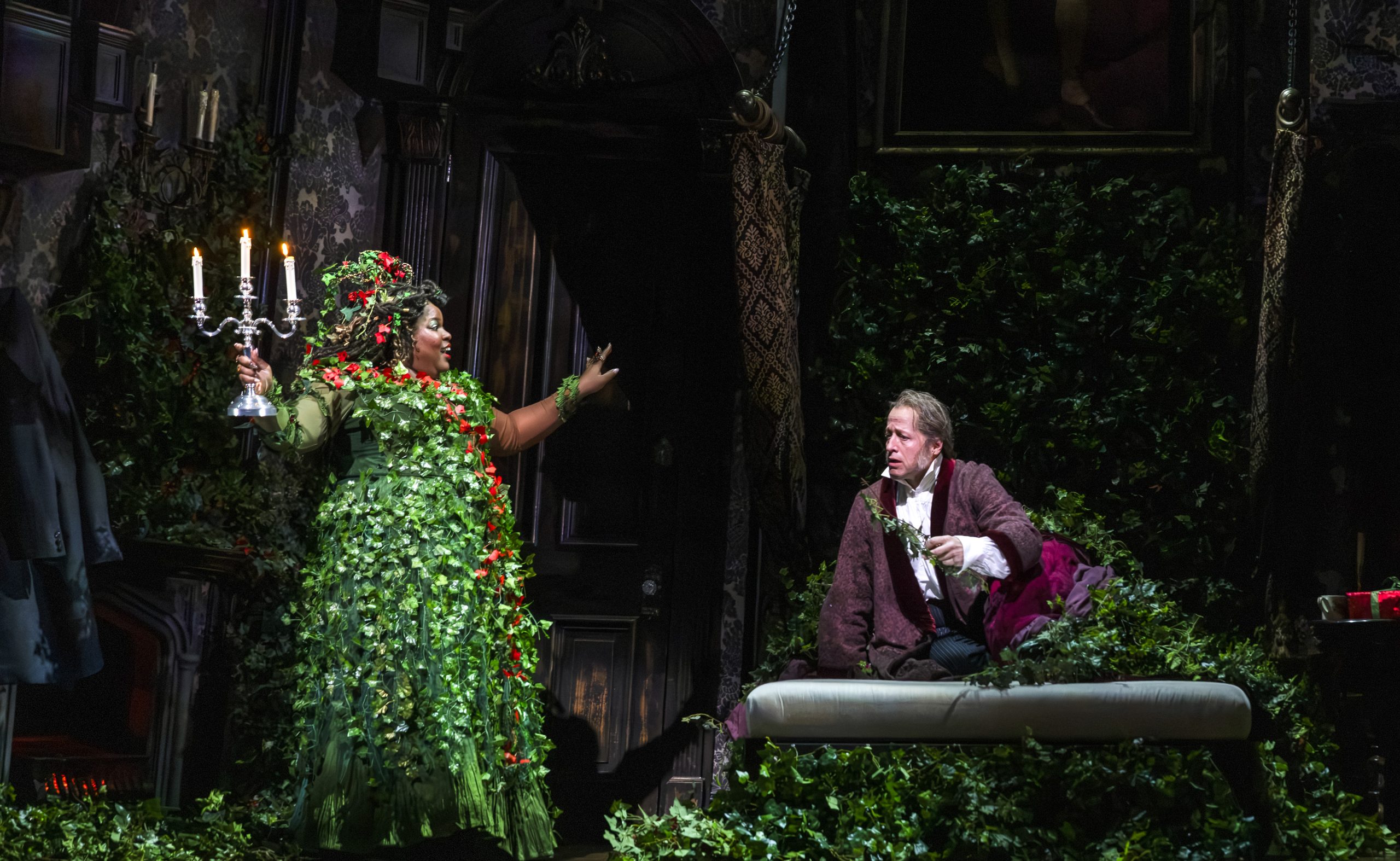
When ghosts of Christmas Past (Rae Gray), Present (Lachrisa Grandberry) and Future visit Scrooge in an elaborate nightmare, the audiences see him through the decades. In Scrooge’s childhood, he’s a boarding school student, sent home to his family to work as an apprentice. As a younger adult, he meets Belle (Tatiana Bustamante) and discovers a fondness for her companionship. However, they get into an argument shortly thereafter when he refuses to leave his shop and celebrate Christmas with her. “I release you,” Belle tells him, severing their engagement. In the present day, he watches as Frida’s family belittles him for his reclusiveness, playing a cruel game of charades where he is depicted as a boarlike animal.
The Ghost of Christmas Future is the most menacing specter of the three. Hulking over the stage in a Darth-Vader-like black robe, the faceless ghost shows Scrooge the most sobering image. He has just died, but his passing is a moment of fanfare for his community. Associates chuckle. Debtors celebrate.
Without context, I had no idea “A Christmas Carol” would leave such an emotional impact. But its message is quietly profound. Scrooge shows us what skeletons we become when our memories of connection and joy are in the rearview mirror.
Still, there’s an inherent whimsy to the Goodman’s “A Christmas Carol,” which offsets its gutting story. “A Christmas Carol” is the Goodman’s bread and butter, annually bringing in cash to the historic theatre company. A fellow critic described it to me as the “Nutcracker for the Goodman.”
The production’s unmistakable charm only accentuates these comparisons. Upon entering the theatre, a children’s choir regaled patrons with Christmas carols like “The First Noel.” In the Goodman’s Albert auditorium, a beautiful curtain with a faded sketch of London’s Thames riverfront adds an elegant touch to the theatre’s atmosphere. At the top of the show, an ensemble gorgeously sings composer Andrew Hansen’s original song “Fellow Passengers,” with live musicians accompanying them onstage.
When Scrooge wakes up from his gothic nightmare, he is a rehabilitated man. “I will live in the past, the present and the future,” he says. “I will not shut out the lessons that they teach!” I struggle to find a more appropriate sermon for how we should all aspire to live.
Centuries after Dickens put pen to paper, the Goodman’s “A Christmas Carol” reminds us that it’s never too late to reverse course.