At the Northwestern presidential inauguration in June 2023, Michael Schill received a gift: a beaded purple medallion in the shape of the letter “N,” given by professor of Learning Sciences and the director of Northwestern’s Center for Native American and Indigenous Research Megan Bang.
“This moment — and the inclusion of Native peoples and our traditions in your inauguration — honors these efforts and marks a first in Northwestern’s history,” she said before handing Schill the medallion.
The token was part of a gift exchange in line with Anishinaabe practices, a group that comprises several related First Nations throughout the Great Lakes region, and represented Bang’s hope that Schill’s tenure would strengthen Northwestern’s relationship with Native and Indigenous communities. Schill reciprocated the gift exchange with a birch basket containing a copper mug, wild rice and wampum shells.
The audience was instructed to stand and remove their hats while the Oka Homma Singers performed an honor song, traditionally performed to celebrate a person’s achievements. The six-piece group harmonized with vocables from the Pawnee Nation while four performers rhythmically beat a drum.
When it came time for Schill to deliver his inaugural speech, he emphasized the importance of inclusion at an academic institution like Northwestern.
“How do we make college more affordable, more accessible, more diverse, more inclusive and more committed to free speech and free inquiry?” he asked.
To illustrate his dedication to these values, Schill referred early on in his speech to the complicated history of one of Northwestern’s founders, John Evans, “a man whom some say was a visionary … others say committed unforgivable crimes against Native Americans” in his complicity in the Sand Creek Massacre.
Over the past decade, Northwestern has increasingly attempted to wrestle with its history to support its students and bridge the gap between the University and marginalized communities. In 2016, the University formed its Center for Native American and Indigenous Research (CNAIR), which led to a minor in Native American and Indigenous Studies that was first offered in 2020.
A key part of Northwestern’s inclusion practices is its land acknowledgment, which recognizes the names of the tribes who were displaced from the lands it now occupies. These acknowledgments prelude many Northwestern events, always emphasizing, per its website, the importance of the University’s “responsibility as an academic institution to disseminate knowledge about Native peoples and the institution’s history with them.”
The land acknowledgement, officially adopted by the University in 2018, is only meant to be a starting point, as stated on the Northwestern land acknowledgment website. Since the formation of the Native American Outreach and Inclusion Task Force in 2013, the University has made ongoing efforts to reconcile its history with Indigenous tribes and amplify Indigenous voices. However, as the University contends with troubled histories and uncertain futures, students say there is still work to be done for Schill’s promise of diversity to be met.
“I think the land acknowledgment is a good start,” says Weinberg and Communication second-year Elias Roberts, who has Oneida lineage. “There’s always more that people can be doing, especially with the history of Evanston…but I’m also simultaneously appreciative of what has been done.”
Unsettled Histories
John Evans and eight other Methodists founded what they called “the North Western University” in 1850. The new town around the school, Evanston, took his name. Evans was chosen to be the president of the Board of Trustees, a position he held for over 40 years. He also contributed more than $100,000 in endowments to the University, mostly in the form of land, which would amount to over $2.4 million today. But Northwestern has struggled to reconcile Evans’ legacy; In addition to being one of the University’s key founders, Evans also facilitated and encouraged violence against Native Americans.
In 1862, after moving west, Evans was appointed Territorial Governor and Superintendent of Indian Affairs in the Colorado Territory. In that dual role, he tried to soften relations between Indigenous communities and settlers. Failing to find success, in the spring of 1864 he decided to separate Colorado Native populations into “friendly” and “hostile” groups, advising the so-called friendly groups to move to designated areas of safety to avoid being caught in the crossfire that might arise between settlers and “hostile” groups.
In a wire to Union General Samuel Curtis and a formal proclamation, Evans said he planned to “whip and destroy” the “hostile” group until “they are all effectively subdued.”
Multi-tribal raiding parties formed and retaliated, believing that Evans’ army had declared war. Evans responded with a new plan, encouraging “all citizens of Colorado…to go in pursuit of all hostile Indians on the plains,” and rewarding them with ownership of any property they seized.
Diplomatic efforts were restarted in the fall of 1864, though Evans himself obstructed them, arguing that the Natives had not been “sufficiently” punished during a meeting with U.S. Army Major Edward Wynkoop. The army he raised had not seen enough battle, he added, and Evans worried his reputation would be damaged if they didn’t.
Evans soon left Colorado and the negotiations with Indigenous leaders to attend to his properties and businesses east, including Northwestern University, though he left a directive to the army to “kill and destroy.”
In Evans’ absence, at Sand Creek in the Colorado Territory, a group of United States cavalry slaughtered around 150 Cheyenne and Arapaho people as they slept in an encampment specifically designated as a safe refuge. Three-fourths of the casualties were women and children. The following morning, the soldiers brutalized the bodies they left unburied.
Over 150 years later, Northwestern is still grappling with Evans’ legacy. In 2013, following growing outcry from students and professors as the 150th anniversary approached, the University commissioned eight professors to analyze its founder’s level of responsibility in the 1864 massacre. Because Northwestern had no faculty with expertise in Native American and Indigenous Studies at the time, four members of this John Evans Study Committee were brought in from other universities. They published their report a few months later in 2014.
The John Evans Study Committee denied in the report that Evans had any direct involvement in the Sand Creek Massacre. They found any evidence linking Evans to a role in planning or supporting the attack was largely circumstantial. However, they noted his support for the forcible removal of Indigenous Americans. Moreover, the report emphasized that Evans chose to defend and rationalize the attack in the aftermath of the massacre.
“In serving a flawed and poorly implemented federal Indian policy,” the report says, “[John Evans] helped create a situation that made the Sand Creek Massacre possible.”
Northwestern’s history with Indigenous tribes runs deeper than its founder’s actions, however, as it occupies ancestral lands of the Council of the Three Fires, which includes the Ojibwe, Odawa and Potawatomi Nations, as well as the Miami, Ho-Chunk, Menominee, Sac, Fox, Kickapoo and Illinois Nations, according to the American Library Association.
The tribes of the Great Lakes area had strong trade relations with European settlers throughout much of the 1700s. But the loss of resources to encroaching Europeans caused widespread starvation; then, violence in the French and Indian War and the War of 1812 decimated Indigenous populations in Chicago.
After the Indian Removal Act of 1830, many tribes were forced to relocate. By 1910, the Indigenous population in Chicago had dwindled to 188. Now, largely due to the work of activists like those at the American Indian Center of Chicago, the city has the third-largest urban Indigenous population in the United States at over 34,000 in 2020.
In an effort to heal the relationship with Indigenous groups, Illinois Gov. JB Pritzker in 2025 authorized the return of the Shabbona Lake State Park ownership title, which is about 65 miles west of Northwestern’s Evanston campus, to the Prairie Band Potawatomi Nation. When the Department of the Interior placed the land into trust last April, it became the first federally recognized tribal land in the state.
“It’s incredible,” said Raphael Wahwassuck, who serves on the Tribal Council for the Prairie Band Potawatomi Nation and presented at a One Book One Northwestern event in April.
“Never mind the fact that the state and the county and local residents have benefited from the use of the land for almost 200 years while our folks have been denied that,” Wahwassuck added, referencing the difficulties in having the land returned.
An Ongoing Reckoning
One Book One Northwestern, which suggests summer reading for every Northwestern student in preparation for related programming through the following school year, has historically been one of the programs through which the University has tried to raise awareness about Indigenous histories. This year, The Night Watchman by Louise Erdrich was chosen; the novel follows the Turtle Mountain Band of Chippewa in the 1950s as they resist termination policies. For the 2015-16 school year, the chosen work was The Inconvenient Indian: A Curious Account of Native People in North America by Thomas King. The book was part of the Native American and Indigenous Initiatives, an endeavor that began in 2014.
These initiatives were spurred by the same momentum that prompted the John Evans Study Committee to be formed, in a reversal of Northwestern’s previous stances on its history.
Until the committee was created in 2013, the University had made no mention of the Sand Creek Massacre, despite its founder’s ties to the tragedy, and had invariably praised Evans. In 1939, then-University President Walter Dill Scott, who wrote a biography on the founder devoid of comment on Sand Creek, remarked that Evans “has had a greater influence on the life of the City of Evanston and Northwestern University, and has done more to create our traditions and determine the line of our development, than any other individual.”
Similarly, a booklet distributed at Northwestern’s centennial celebrations described Evans as “the man whose vision was primarily responsible for founding” Northwestern. While the Report of the John Evans Study Committee agrees that his impact was substantial, it condemns the one-sided histories that had been told before.
Evans’ mark on the University is still inscribed into its alumni center, the John Evans Center, which displays a marble bust of the founder.
In 2024, the John Evans Study Committee wrote a letter to the editor published in The Daily Northwestern, echoing the same recommendation made by the Native American Outreach and Inclusion Task Force ten years earlier: to rename the John Evans Center.
“The issues are no longer tied to the University’s past, but to its future,” the letter says.
The board of trustees denied these calls, claiming, as the letter says, without detail that they had conducted their own “rigorous assessment” of Evans.
The Native American Outreach and Inclusion Task Force was formed to make recommendations to Northwestern on how to repair relationships between communities and begin to rectify its history. It made 59 such individual recommendations within six wider categories. Many of these pointed towards encouraging Indigenous scholarship, especially considering the void thereof that required Northwestern to seek academics from other institutions to confront its own history. One of the imperatives was to “explore the feasibility of establishing an Indigenous Research Center that focuses on producing interdisciplinary research to serve the needs of Indigenous populations, both locally and globally.”
In 2015, Weinberg College responded by forming an Indigenous Studies Research Initiative which hired its first faculty members in May 2016 and spawned CNAIR, though its programming did not begin until 2017.
CNAIR works in four “research hubs”: Global Indigeneities; Nationhood, Law and Governance; Environments, Health and Social Welfare; and Communities, Culture and Activism. It also hosts an annual research symposium, which dedicates a weekend towards sharing Indigenous research.
Similarly, a Native American and Indigenous Studies minor was announced and implemented in 2020. Past courses have included an Environmental Policy and Culture class titled “Land, Identity, and the Sacred: Native American Sacred Site Protection and Religious Rights,” a History course called “Indigenous Peoples and U.S. Law” and an Art History class named “Who is an Object?: Ancestors, Gods and Intermediaries.”
The list of recommendations also called for inclusion of Native American art. Northwestern met that mandate in 2015 with a video project to share Native stories and a Dittmar Memorial Gallery exhibition to honor the victims of the Sand Creek Massacre. Continuing in that effort, the Block Museum of Art is hosting an exhibition titled Woven Being from January to July 2025, which highlights Indigenous art from Chicagoland.
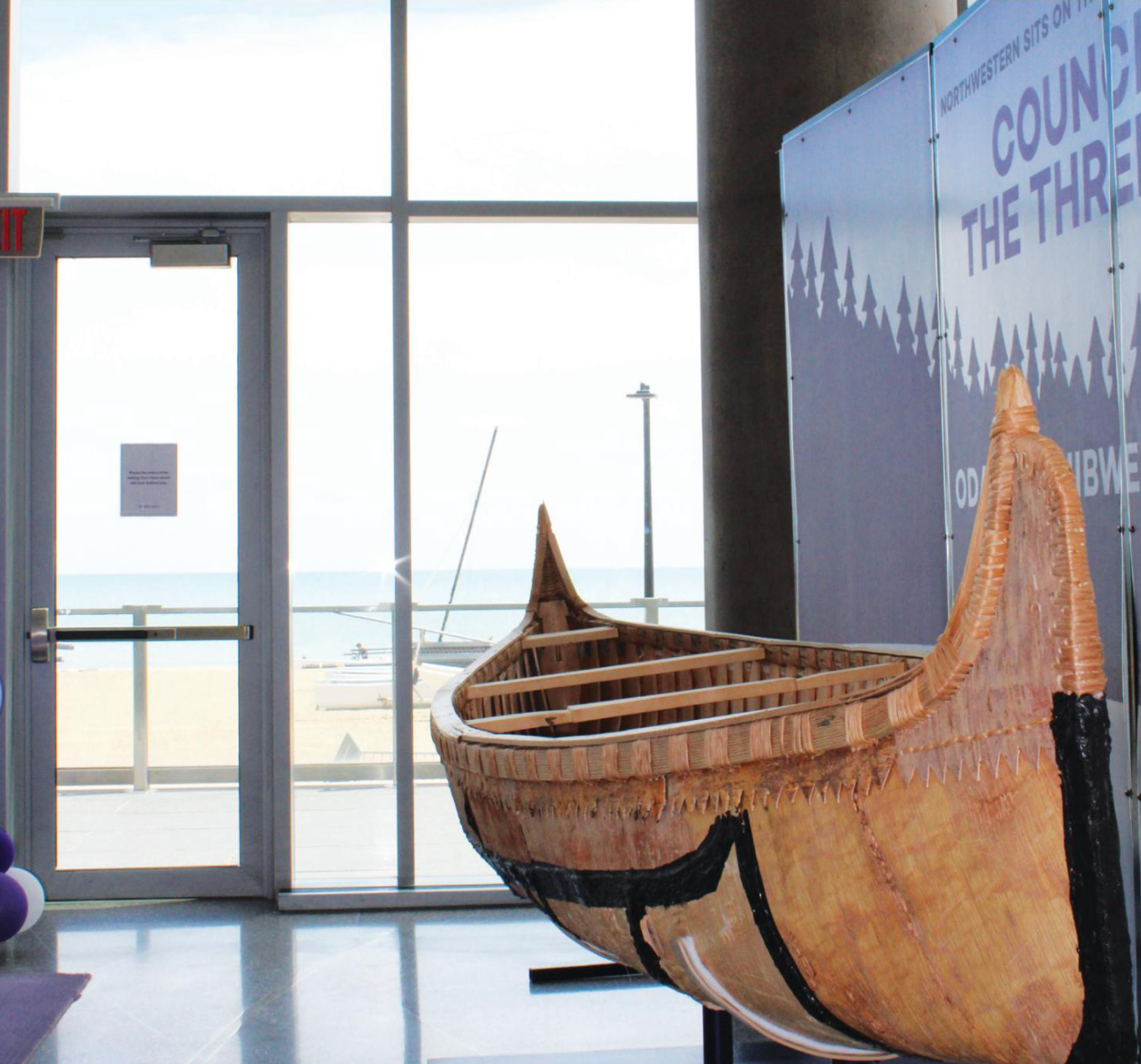
In 2021, Northwestern and CNAIR commissioned Anishinaabe artist Wayne Valliere to build a birchbark canoe which sits in the Segal Visitors Center as an artistic acknowledgment of the efforts made to calm the turbulent relationship between communities. Valliere is one of the few traditional Anishinaabe canoe builders left.
But Northwestern’s contentious history hung over campus in November 2021, when The Rock was vandalized after being painted by students in the Native American and Indigenous Student Alliance (NAISA) to celebrate Native American Heritage Month. According to a statement NAISA released at the time, the group had covered the rock in messages like “Bring Our Children Home” and “Happy Native American Heritage Month.” Vandals spray painted racist phrases over the art.
Northwestern’s administrative staff released a statement in response to the defacement, condemning the graffiti and reiterating its support for Indigenous students.
“As we move forward through Native American Heritage Month, please continue to take care of one another,” it concludes.
Referring to the University’s response as “not a substantial act of support to our community,” NAISA released a list of demands, asking the University to take more concrete steps to support Native scholarship and rectify its history. These five demands included a more forceful condemnation of the vandalism, a meeting between NAISA and Northwestern’s administration and a scholarship for Cheyenne and Arapaho students, which was also recommended by the Native American Outreach and Inclusion Task Force in 2014.
The current moment
To understand the verbal acknowledgement as more than just a loose connection of words, names and images, Northwestern’s land acknowledgement website directs viewers to a series of four lessons for people to educate themselves on histories, cultures and action.
But now, clicking on the links reroutes users to the homepage of the Office of Community Enrichment, offering no avenue for self-education.
Similarly, attempts to find support from the Multicultural Center recently directed users to this statement: “Northwestern is currently reviewing its policies and programs to ensure we meet all federal and state laws and requirements.”
References to diversity, equity and inclusion were also removed from individual schools’ websites following the Jan. 20, 2025 executive order from the White House which mandates the “termination of all discriminatory programs, including illegal DEI and ‘diversity, equity, inclusion, and accessibility’ (DEIA) mandates, policies, programs, preferences, and activities.”
Following these demands, the White House froze $790 million in federal funding for Northwestern. Subsequently, many of the schools’ programs may be in jeopardy.
One such program is the annual Pow Wow, organized by a committee within NAISA. Roberts and Weinberg third-year Kaya Payton, who are co-chairs of the Pow Wow planning committee, found it more difficult to secure the funding necessary to host the event than in past years.
“It’s hard,” Payton says. “Schools don’t know their budgets. They can’t just throw out money like they did in the past few years when their budgets were guaranteed.”
This year’s Pow Wow on May 3, held in the Welsh-Ryan Arena, was the fourth annual since its inception in 2022. The theme was “Honoring our Relatives.”
The timing also coincided with the National Day of Awareness for Missing and Murdered Indigenous Women and Girls on May 5. Information booths educated attendees on missing and murdered Indigenous women while red shirts and dresses were draped over the stands as symbols of those losses.
Other booths sold merchandise, including clothing and jewelry, as well as still life sketches and sepia photographs. A line of attendees wrapped around itself several times over as they waited to purchase Indigenous food like fry bread.
At the center of the Pow Wow on the gym floor were a series of drum circles keeping time for an ever-rotating cycle of attendees dancing around the logo, who only occasionally dispersed to give space for student artists and performers like a mariachi band. Anyone in the crowd could join in the dance; some gray-haired, some college students. Children and toddlers skipped to the rhythm as their feet sliced through the air; others were hoisted high, taking flight in the hands of their parents.
“Everyone feels like family there,” Payton says. “Even though we are all different tribes, it still feels like a community with a sense of familial connection because I’m around other Native people.”
The Pow Wow was open to any student, regardless of heritage, to share and learn about Indigenous cultures. Preparing for it also gave Payton a deeper connection to these histories and cultures, despite having grown up going to powwows for much of her life.
“I’m learning a lot I didn’t know going into this role,” she says. “I’m learning more traditions from different tribes and different people. That’s cool to see.”
These events are crucial for both building community and reconnecting with one’s culture. Roberts appreciates these opportunities to become closer to Oneida culture and family.
“I remember during COVID my brother, my dad and I took language lessons for my great aunts,” Roberts says. “Hearing them talk about tribal things that I normally didn’t hear was really special.”
The Pow Wow works to expand a community that has only recently gotten any meaningful attention from Northwestern — attention which may be once again at risk. The visibility and awareness brought by this programming is crucial in supporting and making visible Indigenous communities on campus, Roberts and Payton agree.
Events like this on-campus powwow are not necessarily easy to come by, Roberts says, remembering stories his dad told him about their travels from Virginia to Wisconsin in order to attend a powwow when he was younger. Payton too would make a yearly 10-hour trip to seek that connection.
“I came to Northwestern because there was a community waiting there for me,” Payton says. “It’s really important for representation and having that sense of community away from home.”
At the Pow Wow, NAISA distributed a zine composed of student art and stories; family photographs and histories.
The back cover reads: “This is dedicated to all the ancestors before us, with whom we share the community and those to come.”
Print design by Leila Dhawan.