Psychological thrillers often evoke a sense of mystery, with a side of bone-chilling terror that one can’t quite place. Verity isn’t one of these movies; it feels more akin to a Spanish soap opera produced by The CW.
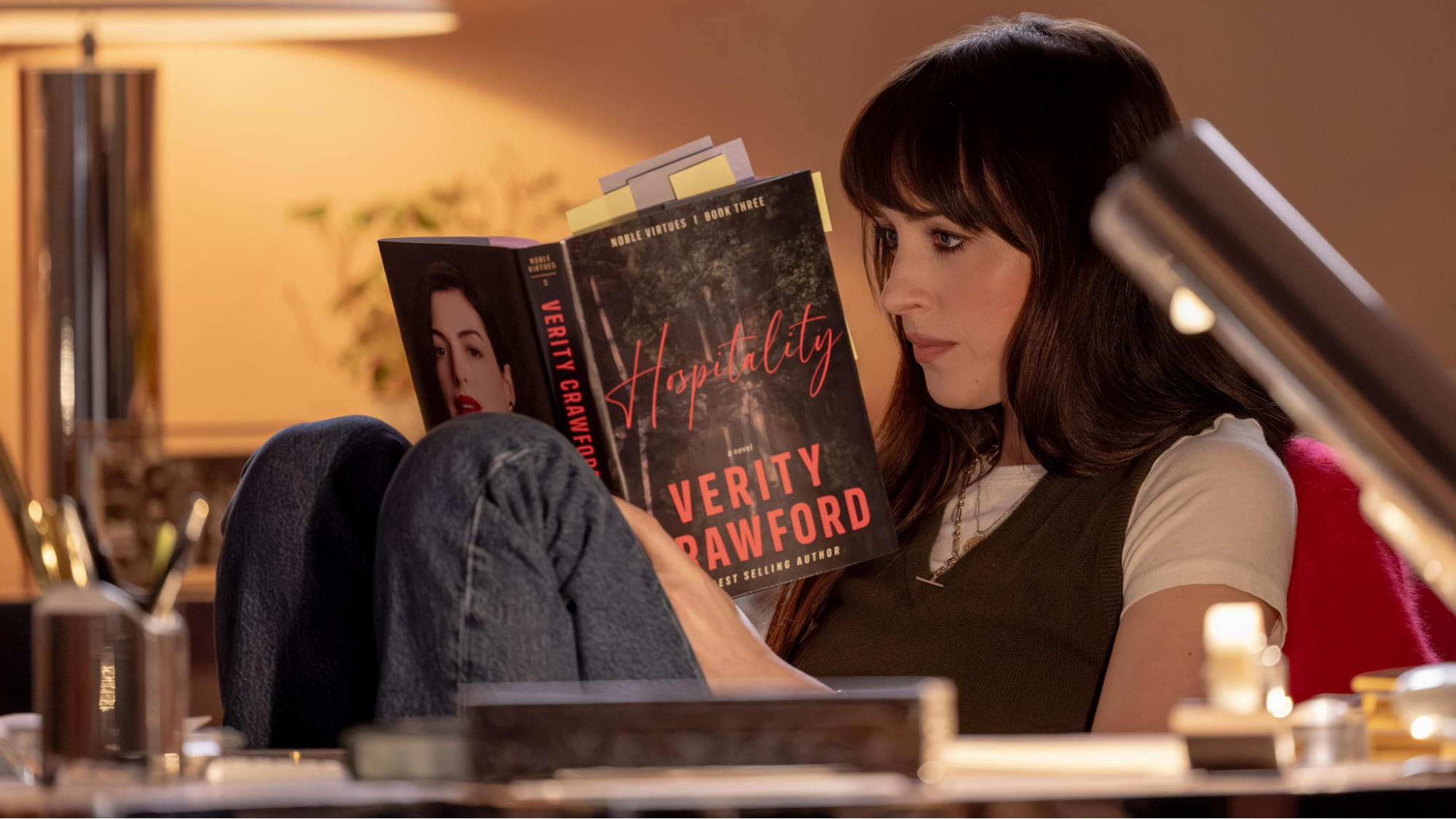
Verity, an adaptation based on Colleen Hoover’s popular novel of the same name, was released in theaters on October 2. The film follows ghostwriter Lowen Ashleigh (Dakota Johnson), who is hired by famous horror author Verity Crawford (Anne Hathaway) to finish the last three books in her series. After moving into the Crawfords’ mansion, she finds an autobiography that makes her question everything.
In theory, the premise of Verity is strong. In reality, its choppy editing, cringy dialogue and half-baked suspense bring it down. Verity is just bad.
I’d argue the worst aspect of this movie is the writing. Oftentimes I was left wondering who anyone was. I couldn’t even remember the name of Jeremy Crawford (Josh Hartnett) until midway through the film, and he’s Verity’s husband. While it makes sense that a film about finding a villainous autobiography would rather tell than show, it does so horribly. The movie relies heavily on flashbacks based on Verity’s manuscript to showcase Jeremy and Verity’s characters, while Lowen’s character depends on her inner monologue and her conversations with Jeremy. A majority of these characters say how they feel or what they’ve gone through. Even during flashbacks, most of the story is being told through narration and dialogue rather than character action.
Nobody in this film feels real, and their complete lack of depth is a big reason why. Lines like “resting bored face” land with a thud. Conversations never sound like two people talking, just actors speaking at each other. At the start of the movie, Lowen witnesses a man get hit by a car, prompting a stranger (Jeremy) to take her elsewhere to get cleaned up. Jeremy stays in the bathroom as she washes up. This somehow leads to them competing over who has worse trauma, but the actors deliver their lines like a grocery list rather than creating a bonding moment.
Despite all the flaws, some of the acting makes this movie bearable. Hathaway is the best part by far, bringing a strange, liminal sweetness to scenes that are meant to disturb the viewer. Verity’s first onscreen appearance, when Lowen is introduced to the paralysed author, is particularly striking. Hathaway is completely still the whole time, but her glassy eyes create an ominous presence that feels more sad than haunting. In a way, Verity always felt ghostly alive. The Crawfords’ son Crew (Brady Wagner), is a standout, bringing life to his character even with little screen time. My eyes remained hooked on the screen as he told Lowen that “mommy said” he can’t answer any questions about her, followed by his mouth bleeding after biting into a knife. Crew’s fear when being interrogated by Lowen really transcends the screen, creating one of the few moments in this film that didn’t need music in order to be scary.
Somewhere in my brain I’m still wondering how to feel about Johnson’s performance. Most of it felt like her staring at the camera rather than delivering emotion. One scene in particular is the restaurant scene, when after finding out that Lowen’s birthday has passed, Jeremy insists on taking her to a restaurant to celebrate. At said restaurant, Lowen admits no one has told her that her writing matters. What should be an emotional confession sounds more like a bored complaint. Hartnett was also there. He had a performance, but it’s nothing noteworthy. His scenes were mainly him reacting in a very exaggerated manner, supplementing any depth he could’ve added with pronounced facial expressions. Generally, his scenes tend to blur because of this, making it so no one scene is more defining than the others. I’ll be nice, since they’re working with lackluster material, but it’s interesting how Hathaway and Wagner gave better performances with the same script.
The suspense is lackluster as well. According to Jeremy, Verity is supposed to be paralysed. A little later in the movie Lowen sees Verity’s head move and freezes, causing her to drop her mug and wonder if she’s going insane. While this moment is supposed to be a thrilling twist, the music does all the scaring. Using ominous music that intensifies in pitch, growing louder than the scene’s audio to emphasize Verity’s movement. The editing feels closer to a teen’s iMovie project than a thriller production, with little to no tension building up before the score kicks in. This film plays like a child’s paranoia when left home alone for the first time — loud, with a bad foundation.
Don’t even get me started on the sex scenes. Most happen in flashbacks Lowen imagines while reading Verity’s “autobiography.” One instance that comes to mind is when Verity is looking in the mirror, squishing in her pregnant stomach. Jeremy walks in behind her, expressing how excited he is about having twins. Somehow this leads to them having sex on the bathroom sink. This scene, along with many of the others, feels like it was added to make me care more about the characters. No, sex scenes don’t make me care more about your characters, especially when the leads share too little chemistry to make any romance believable.
The tone is uneven too. A child’s death sits at the center of the story, yet the film rarely treats it with the weight it deserves. Oftentimes the death of Verity and Jeremy’s daughter, Harper, is used to push Jeremy’s relationship with Lowen. When Lowen first sees a picture of Harper, Jeremy gets emotional and she hugs him. The scene then shifts from focusing on Harper’s death to Jeremy kissing Lowen’s forehead, propelling their love story. Most scenes like this place an emphasis on their romance while utilizing dramatic close cuts, completely sidelining such a sensitive moment.
What stays with me is an idea this film barely addresses: This is a killer doppelgänger movie. Lowen slowly begins to resemble Verity, the woman whose voice she was hired to imitate. I realized this around the midway point of the movie, when Lowen and Jeremy first sleep together. During the act, there was a focus on Lowen biting the frame of the bed, which is something Verity said she did with Jeremy earlier in her “autobiography.” Some other moments in the film also strike out as being rather skinwalker-ish. Before the restaurant scene I mentioned earlier, Jeremy says Lowen can borrow a dress from Verity. When looking through her closet, Lowen picks a red dress as she remembered Verity wore a red dress the night she met Jeremy. Despite showing how similar the two women are, the movie never directly acknowledges it. Instead it focuses on showing scenes from Verity’s “autobiography,” including unnecessary sex scenes to fill time.
With all this in mind, fans of the book may enjoy it as an adaptation, but anyone hoping for a real thriller will find better chills by standing in front of a freezer.