17-year-old Ava Johnson hears and makes six-seven jokes up to 10 times a day at her high school in Odenton, Md. She loves how new numbers keep popping up in Gen Z humor, and the older ones now make her feel nostalgic. Above all, Johnson loves the feeling of being in on a generational inside joke.
“I think it’s funny when no one knows what you’re talking about,” 17-year-old Johnson said.
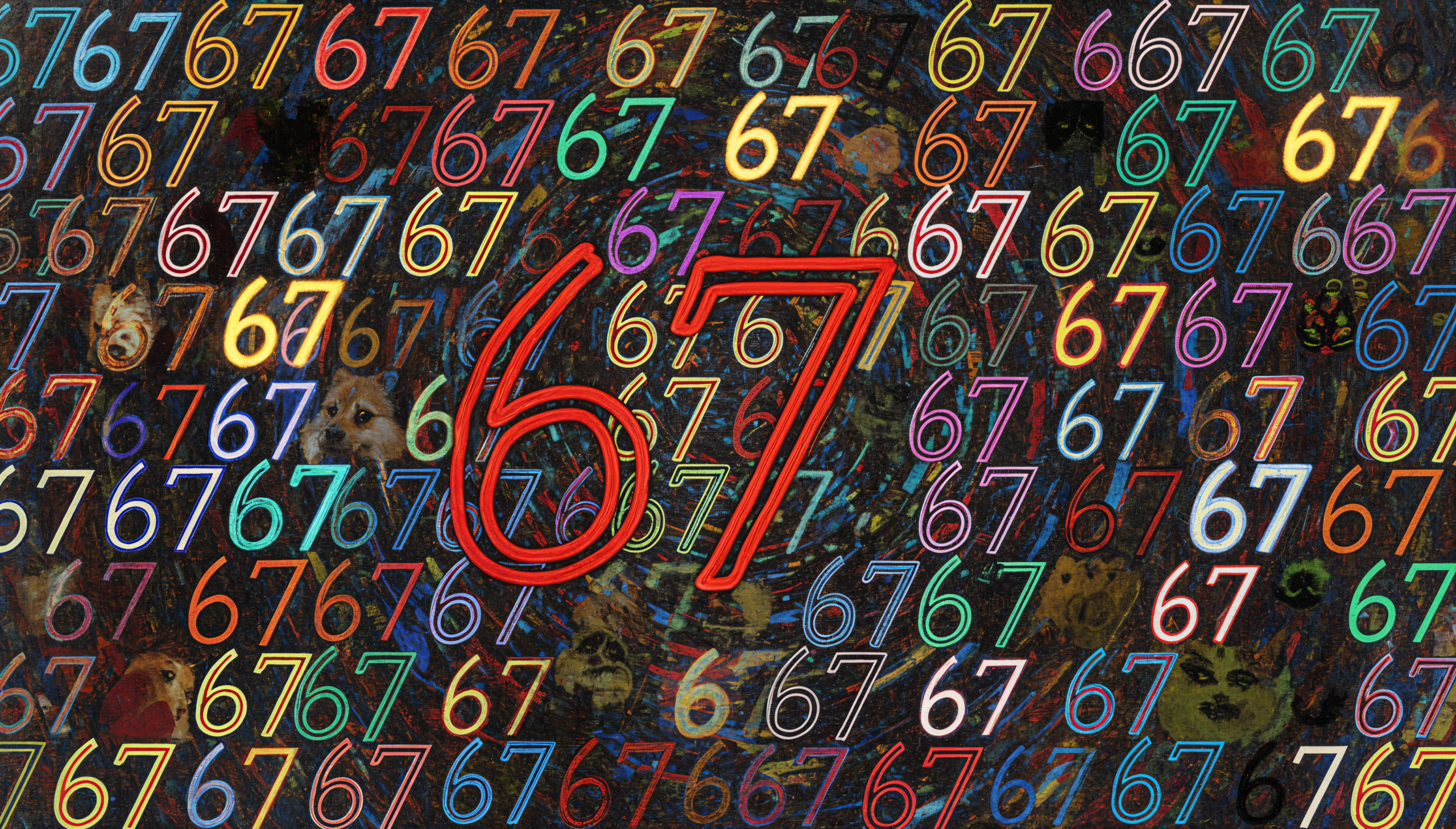
By now, you’re undoubtedly familiar with “six-seven” — and, if you’re a parent or teacher, a little more familiar than you’d like to be. Named Dictionary.com’s Word of the Year for being a “linguistic time capsule,” “six-seven” first became a meme from a basketball TikTok edit to rapper Skrilla’s song “Doot Doot.” The catchphrase has since spread across the internet and spilled into schoolyards, classrooms and college campuses. Whenever that figure appears, tweens, teens and young adults exchange winking smiles and chant “six-sevennn!”
This is far from the first time numbers have gone viral. In 2013, a video posted on the now-defunct short-form video platform Vine popularized “What’s nine + 10? 21!” A couple of years later, Fetty Wap’s “1738” was taken from a rap reference to a brand of cognac and turned into an internet meme, repeated ad hominem by teenagers with little reference (or even knowledge) of its source. This year, six-seven joins the internet’s ever-growing numerical dictionary, where seemingly random numbers take on meaning as snapshots of Gen Z’s digital culture. On the horizon, 41 is gaining momentum as the next big wave in numerical nonsense.
The point is its pointlessness
Blake Hu, a Chicago-based software engineer and a Class of ’25 Northwestern graduate, has seen the cycles of numbers in Gen Z humor. If you’re trying to decode the numbers’ meaning, you’re already missing the joke, he said.
“Gen Z kids want to feel like they’re in on something, and they want to buck the older generations,” Hu said. “They latch onto these memes that don’t really mean anything, but it creates an ‘in’ and ‘out’ group depending on whether you understand it.”
Even if the jokes seem to make no sense, there may be a logic behind the pattern that helps to explain Gen Z’s attraction to it.
Christopher Gilbert, who teaches media literacy and American humor at Assumption University in Worcester, Mass., said Gen Z’s embrace of nonsensical humor serves as a defense against the world’s despair. In other words, it’s an act of rebellion that challenges conventional ideas of humor and meaning.
“There is no good way out of a world that’s drifting into AI without any purpose behind it beyond, ‘How can we monetize it?’” Gilbert said. “What other option is there for [Gen Z] to do when they’re trying to make sense of a world that seems completely out of control?”
Using bizarre jokes to rebel against society dates back generations. Aidan Walker, an internet culture researcher and a former writer for the online database “Know Your Meme,” recently posted a TikTok drawing parallels between Gen Z’s “brainrot” humor and Dadaism, a post-World War I artistic movement that mocked the conventional and embraced the illogical.
In the video, Walker likens six-seven to Marcel Duchamp’s “Fountain” (1917), an upside-down urinal sculpture at the Tate Modern in London. Duchamp submitted the piece to the Society of Independent Artists’ exhibition in New York, whose board declined to display it because it was not art. Just as it questions what society deems “real art,” Walker argues that six-seven and other absurd, numbers-focused aspects of Gen Z humor expose and critique the social constructs that define humor and reason.
“The work of art isn’t in the urinal itself. The work of art is him doing that, and then you sitting there wondering what the meaning of the meme is,” Walker said. “It has no meaning.”
Humor, hollowed
At one Maryland dance studio, six-seven is banned. Johnson, who teaches four- and five-year-olds at the Odenton dance center, says the studio’s director added six-seven to the list of banned words. Johnson believes most of these kids are simply repeating and laughing at a meme they learned from their older siblings and are unaware of its meaning or origin.
“When the ‘21’ trend happened, I think I was, like, in elementary school,” Johnson said. “My parents didn’t let me use a phone or anything like that. So I would say it because I heard everyone around me saying it, but I didn’t necessarily know what it meant.”
Similarly, SESP third-year Tok Lin Yeo regularly cracks six-seven jokes with his peers and remembers when he instead chose “1738” and “21” years ago. But their origins remain a mystery. “I think it’s funnier that there’s no deeper meaning,” Yeo said.
This dimension of numerical humor, Gilbert argues, sets it apart from Dadaism. While the art movement championed life and creativity over the death and destruction of war, Gen Z repeats memes without much thought toward their origins or purposes. Gilbert calls it resignation, not resistance.
It’s all gonna be over soon… right?
As “21” and “1738” predict, the lifespan of “six-seven” is limited. As media coverage fumbles with its meaning, and politicians, churches and other institutions use it in social media marketing, it loses its edge and becomes another basic punchline.
When she scrolls on TikTok, Johnson said she can’t escape videos of teachers making the “six-seven” joke with their students. Every time she watches them, she groans. “I think when older people start to get on jokes like that, that’s saying the thing is over… It kind of ruins it,” she said. “It’s like, okay, it’s kind of cringe now.”
Gilbert calls six-seven a “phrase regime unto itself”: slang with a self-contained set of rules and social conventions. He argues that its nonsensicality gives it meaning; yet, as the term continues to circulate and acquire familiarity, it gradually loses that absurdity and undermines its own meaning — and its vitality.
Still, Johnson thinks that if she hears a six-seven joke decades from today, she would still find it funny.
“I would probably be shocked, like, ‘Did you actually just say that?’” Johnson said. “Like, that would kill me.”