What does reality look like when it starts to unravel?
For cinematographer David Bolen, the answer can only be found through radical experimentation. His ongoing creative partnership with director Lance Oppenheim has produced a body of work that challenges conventional storytelling, including Some Kind of Heaven (2020) and Spermworld (2024). He has also shot music videos for artists including Camila Cabello, Doja Cat and Kendrick Lamar.
In Primetime (Sept. 25, 2026), Oppenheim and Bolen’s first nondocumentary film together, Bolen pushes the boundaries of conventional cinematography to build a surreal visual world that encapsulates the spectacle of early 2000s reality television. He has also collaborated with Oppenheim and filmmaker/comedian Nathan Fielder on You Can See Everything (Oct. 16, 2026). With both now playing in theaters, Bolen discusses how a film’s visual language emerges through experimentation and his personal approach to filmmaking, with a focus on making Primetime.
This interview has been edited and condensed for clarity. At the time of this interview, press interviews for You Can See Everything were not being conducted.
Primetime often blurs the line between what is actually happening and how Chris Hansen (the protagonist) perceives his reality. How do you approach understanding a character’s subjectivity and translating it into something the audience can see and feel?
I think Lance and I are generally much more interested in a subjective experience than an objective one. I don’t think objectivity has ever been super interesting to us. I think as soon as you have a camera in a space, objectivity kind of goes out the window because people perform differently when the camera is around. That’s always fascinated us.
In Primetime, exploring things subjectively has always been our priority, and I think we were more so interested in what these characters were going through on an emotional and personal level. Rather than just presenting things in a traditional kind of biopic way, we wanted to go deeper into how they perceive the world and how they see things. For us, it’s about telling a story with a camera through people’s perspectives – what they’re seeing and experiencing and going through. And most of our decisions are kind of related to that.
The question is never, “How do you cover a scene?” It’s, “How do you cover a scene through what this person is experiencing, feeling and perceiving?”
Films bring together so many different art forms: screenwriting, acting, costume design, music and cinematography. Lance Oppenheim has also talked about deliberately introducing some chaos and spontaneity into the making of Primetime. With so many creative voices and unpredictable moments, how do you ensure the final film is cohesive?
It’s one of the main jobs of the cinematographer because making individual scenes interesting is an easy task. But making a film interesting as a whole is much, much harder. And trying to understand a script from start to finish and have a visual through-line that’s cohesive is probably one of the hardest tasks.
On any given day of a shoot, you can be shooting page 73, and then the next scene, you’re shooting page 14. And there’s a lot of whiplash as part of that process, not just for actors, where they’re kind of like dealing with jumps between their characters’ emotional states, but also on a visual level.
You always want a film to go from one place to another. And I think in this film, we wanted the film to progress from something that felt maybe a little bit more grounded in reality to something that felt much more heightened, like a fever dream that’s very surreal. So, at all points in the process, you’re kind of questioning, is this not far enough or is this too far? And you’re constantly collaborating with the production designer, the composer, the editor, to kind of make that decision together.
I think what’s special about Lance’s projects is that the collaborators don’t all live on separate islands. You know, I’m constantly talking to the composer and the editor and the production designer from pre-production all the way through post-production. We’re talking about levels of reality and how far we want to push things at a certain moment. I think a lot of the time a DP never meets a composer. But I’m very close to the composer, and he was often sending me music while we were shooting. I think that helps create stylistic cohesion in a film.

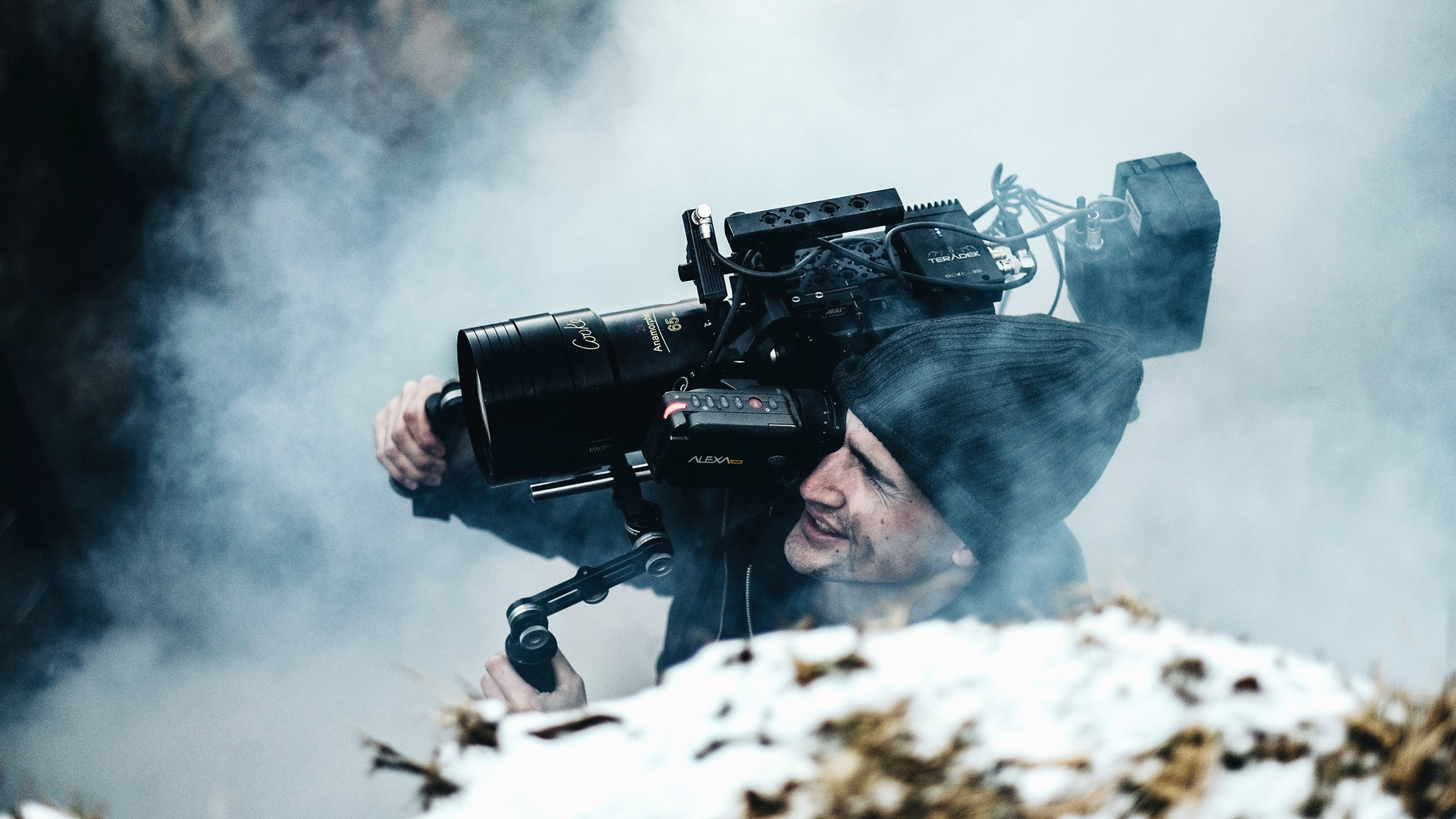
One of the most fascinating things about Primetime is the use of 12 different camera formats (including a colonoscopy camera to film a visual sequence of traveling straight through a computer monitor). How did you decide which cameras were suited for particular moments?
Lance and I aren’t people who go in knowing everything. I think our process is quite chaotic and messy, and it’s all based on experimentation. Lance and I will come up with a thousand different ideas, and a lot of the time it doesn’t work.
With the colonoscopy camera, for instance, I was initially thinking we’re gonna shoot this on an Alexa (gold-standard digital camera for shooting movies today). That would mean that we would build a crazy rig that’s like a massive computer, and that I’ll push through the screen and show a giant space of cables and wires. This way, a viewer can get immersed in the realities of that moment. That ended up being impossible. But that’s the process of experimenting and trying things. Many of the formats in the film weren’t decided in pre-production. We just experimented with a thousand things, did a taste test and thought, “oh that one tastes really good; let’s make more of that.”
With Lance, no idea is stupid and everything is a possibility. For a lot of people, if you pitched a colonoscopy camera, they would say that is going to look dumb. But Lance is energized by the idea of doing things differently. And I think that’s what makes him so special, like there are no kind of boundaries or perimeter. The more you’re outside of that perimeter, the better for him. It’s rare nowadays since I think most people have the tendency to live in the box.
Could you break down the process of shooting your favorite scene in Primetime, and what the process of experimentation and discovery looked like there?
My favorite sequence takes place in India in the film. We actually shot that in Sri Lanka because we couldn’t afford to shoot in India, and Sri Lanka was a slightly cheaper option. We shot this part much later in the process, around March this year, after we had shot most of the film. At this point, we were fully in experimentation mode and people kind of knew what the film was at that point. The executives weren’t too nervous anymore about what we were doing.
We shot the sequence on an Alexa, a DV (Digital Video) camera (handheld camcorder) and all sorts of other things. And the funny thing about that sequence is that it’s actually the most conventional in the formats of the film. We experimented and found it’s not necessarily the craziest thing that’s always right. In this case, going with Alexa was the best thing to do.
What was fun about that was the color. We were just pushing and pushing and pushing the visuals to be dreamier and we blurred and obstructed the images to make them look kind of crazy.
Another fun thing about that sequence in terms of experimentation was the creature. There was initially this kind of mythological creature that’s stalking Chris Hansen. When we initially shot the film, the creature’s outfit was a total failure. It looked silly. A lot of our creature shots in the final film came way later in the process. We needed a flash of the creature to go in kind of a rain sequence later in the film, but we didn’t have a rain machine in Sri Lanka. One day, we found a waterfall late at night and thought we could just shoot it right there and put the actor under the waterfall. This is just another example of doing things unconventionally and letting the world present things in a very organic way.

What visual details do you wish audiences paid more attention to in films, whether it’s something you made or someone else made?
I think all artists have tendencies to want to be noticed and acknowledged. It’s funny for cinematographers because, in many situations, you’re actually hoping that people don’t think too much about what you’re doing. You’re trying to create a look that is perfect for the film that’s beautiful but doesn’t necessarily distract from the story itself.
Luckily, for Primetime, this was an opportunity to do something really crazy with the visuals because the characters themselves are crazy and we can kind of like play into that. Whereas I can’t speak a ton about it, but with You Can See Everything, there is a very different style: it’s subtle and presentational and felt right for the project. I don’t even want audiences to be thinking about it too much. I would hope that the work is just kind of perfect for the film itself.
In a previous interview, you spoke about the challenge of making meaningful art and making art for commercial purposes. How do you navigate the tension between making something personally meaningful and making something that will sell?
I learned a lesson very early in my career when I was presented with two options for a film: shoot a feature film with some big stars attached and have more money than I had ever had on a film, or shoot Some Kind of Heaven (2020), Lance’s first documentary feature, which had almost no budget and very little support. I had a belief that there was something emotionally special about that project, and I had a belief in Lance as a creator and an artist. Some Kind of Heaven ended up going to Sundance and doing a lot of things for our careers, whereas the other film ended up bombing and not doing anything.
As an artist, I feel that you shouldn’t even really be thinking about things like whether a project is commercial or not. I think your best work comes when you’re deeply invested emotionally, and if you are, you’ll do really special work that audiences acknowledge and love.
I know nowadays you’re always thinking about the economics of things. But I try to think purely on a level of whether I can make something special and whether I am the right person to shoot a film. If you don’t have the relentless urge to do it, then you shouldn’t be doing it. I try to listen to my instincts as much as possible when selecting projects.
What are some of your favorite films made by other filmmakers?
Cameron Crowe is like a massive influence on me. I love all of his films, like Vanilla Sky (2001) and Jerry Maguire (1996). Those were both really formative movies for me and have a deep influence on my style.
I’m a huge fan of the film Donnie Darko (2001). I think it’s like such a special film and it took such artistic and tonal risks, doing things that no one else was doing.
In terms of cinematographers, I’m very inspired by Bradford Young. He doesn’t make a lot of films, but when he does make one, it’s really special. His work has always been a reminder to not make films unless they really mean something to you and if you have something to offer through them.
I could go on forever, but those are kind of the main ones for me.