
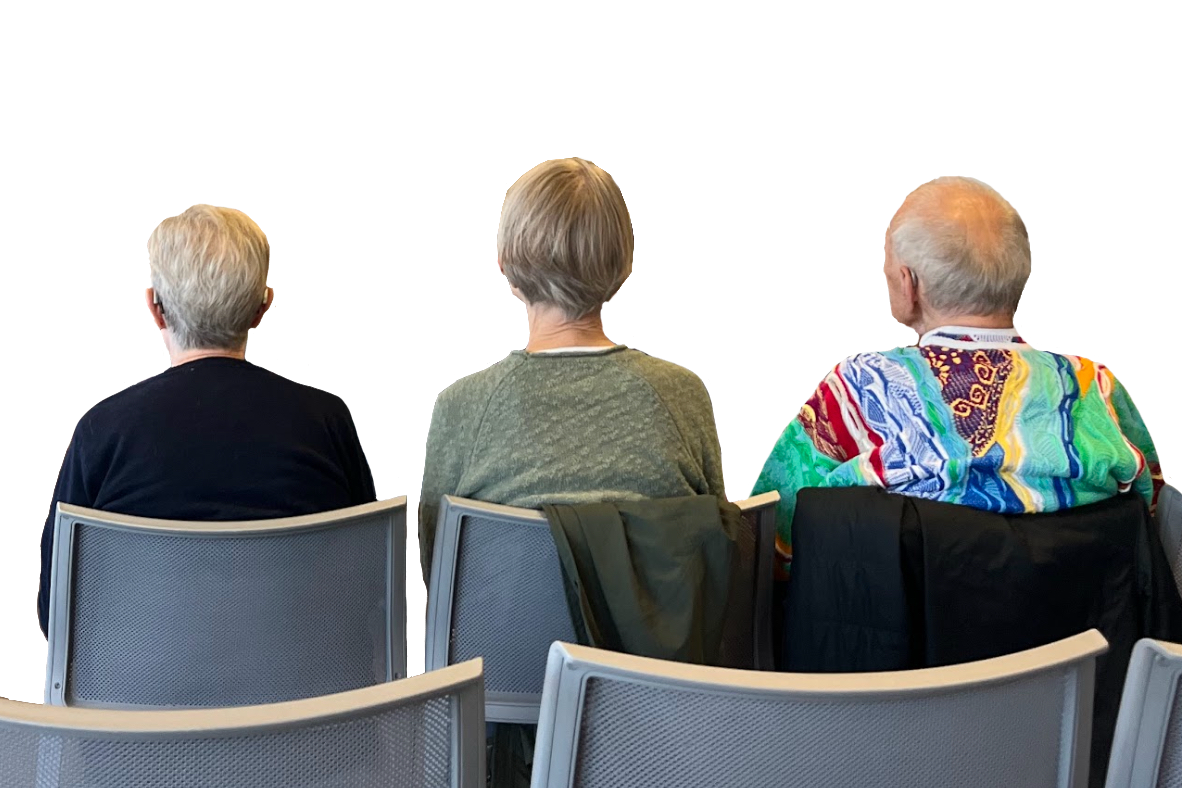
On Tuesday and Thursday mornings, students begin arriving at Norris at 8 a.m. sharp, right when the doors open. They get their coffee at the empty Starbucks, chat with partners and friends or read the paper. Gray hair, glasses and hearing aids are sprinkled throughout this group of students, who head to the elevators to get to their 9:30 a.m. class in the second-floor Northwestern Room.
As the lecture commences, there are no open computers with The New York Times Games; no phones, AirPods or distractions. Every student has their head up, listening attentively to the professor for the full 90 minutes.
And then of course, a piercing phone ringtone plays. It takes a few tries to turn it off.
These classes are part of Northwestern’s Continuing Education Program, which is run by The Alumnae of Northwestern University, a board of women committed to “Engaging Minds, Enriching Lives.” The program began in 1968 and offers noncredit courses open to the public. They cater to retired individuals — not just Northwestern alumni, but anyone interested in resuming their education.
Never stop learning
This quarter, the program offers four courses taught by current Northwestern professors with subjects ranging from Political Science and Philosophy to Radio, TV and Film (RTVF). It also offers The Alumnae Lyceum, which features nine different professors who each teach one class over the course of the quarter.
“[The Lyceum] allows some of our subject matter experts who cannot teach a full course to pop in and do what they do best,” says Kristen Mercker (Speech ‘86), co-chair of the Continuing Education committee. “It’s eclectic, and it’s just wonderful.”
Mercker works with professors to design each class’s curriculum. As an undergraduate at Northwestern, she was involved in radio shows and music video production.
“My skills as a writer, producer, director, are a really good fit for this because, basically, I’m putting on a show,” Mercker says. ”As a committee, we want to make sure that we are representing all departments and schools and are offering engaging lectures. So we want to see over the 12 courses … Is there something for everybody in the community to enjoy or engage with?”
Although the courses are not about current events, Mercker thinks relevance might have something to do with why certain courses are particularly popular.
“Some of our students are coming to the history and the political science sort of courses to give context for today’s headlines,” she says. “They’re feeling anxiety and want to understand better what they’re reading every day in the paper.”
To lighten things up, Mercker is working with Stone to create a thematic class focusing on sources of hope and inspiration in the coming quarters.
Although a math class was offered in the past, Continuing Education classes, are typically humanities-based.
“We get some former McCormick students who … come to our classes and they go, ‘I’m getting my second Northwestern education!’” Mercker says. “Their curriculum was so focused and so packed they didn’t have time to take humanities classes.”
Sandra Lewis (College of Arts and Sciences ‘76), is a student in the Thursday afternoon United States Foreign Policy course taught by political science professor Daniel Krcmaric. She says she decides to enroll in classes based on pre-formed interests.
“In the fall of last year there was one course that was tangentially related to the field I worked in my whole career,” Lewis says. “So then I obviously wanted to take that class.”
Although she was already knowledgeable on foreign policy, she is grateful that the courses are designed for people who may not have experience with the subject.
“They have to put together a program that is at a high enough level for the people who spent their careers working in that field,” Lewis says. “Yet they also have to be general enough that someone coming to this topic with little background would be able to understand and follow the whole course.”
Operations Co-chair Deborah Hudson (SESP, M.E. ‘75) has been a member of the Continuing Education committee since 2012. She deals with the nuts and bolts of programming, such as scheduling, booking and communications. She is also in charge of designing and creating the brochure, which is where students get in-depth information about the program each quarter.
Going online
Lewis retired at the beginning of the pandemic, which was a time of adjustment for the Continuing Education program. Hudson says the organization had to pivot to survive. All classes became available on Zoom, and that didn’t end with the pandemic.
“We came back saying ‘Oh let’s try this live streaming,” Hudson says. “So that added a whole new level of technicality.”
Lewis started attending classes through these Zoom sessions, and she still rarely comes in-person. With a 40-minute commute to campus, it’s easier to stay in the comfort of her own home.
“The other thing I like about Zoom,” Lewis says, “is if the class conflicts with something that you have scheduled in your life that you can’t change, you can just watch the recording.”
While adapting to COVID restrictions was a challenge, new opportunities arose. The organization realized it could even expand beyond Evanston.
“It was fun, because when we first started Zooming, there was a woman who was visiting her cousin here, but she lives in Paris,” Hudson says. “But she actually had really good Wi-Fi that allowed her to Zoom into our classes from Paris. That was one of our first experiments from out of this country.”
Hudson says there is also a Beijing-based student enrolled in a class this quarter.
Crafting classes
RTVF professor Brett Neveu is currently teaching the Thursday morning Behind the Scenes: Conversations with Filmmakers, Play Creators, and Entertainment Industry Insiders class, focusing on the development of theater and film pieces. The inspiration for the class stemmed from his graduate class where students split the time between workshopping ideas and then having conversations with guest speakers in the performance industry.
For the Continuing Education version, he shifted the course to focus entirely on guest speakers.
Neveu says there is variety in the roles of the speakers and where they are based. He says he enjoys the dialogues in class, leaning on the guests while they keep the crowd attentive.
“I try to find the most interesting people from all corners of the industry,” Neveu says.
His drive to instruct this generation stemmed from his work at Northlight Theatre in Skokie, Ill. where he taught a writing class for older students wanting to continue creative learning. Once he found this opportunity at the University, Neveu immediately began to collaborate with the association.
“I’m always trying to find ways to sort of stretch my teaching knowledge and things that I’m interested in and share that with a larger group,” Neveu says.
While the material of the class is similar to those of his undergraduate courses, there are distinctions in the structure.
“They’re kind of different because it isn’t like ‘Hey, here’s a grade’ or ‘Here’s your homework,’” Neveu says. “It’s mostly going in and presenting information, asking questions … more of a dialogue with the students than practical application toward a project or writing a paper.”
The size of the classes can range from 12-person workshops in Norris classrooms to Zoom calls filled with students. Neveu’s class on Thursdays is hybrid, with about 70 in-person attendees and another 50 logging onto the Zoom stream.
Alumni and residents alike can register for these classes through the Norris Box Office website. All details are located on the Continuing Education website, along with an extensive FAQ section (created by Mercker) to answer many of the technological questions, which is especially needed for this student demographic.
Building for the future
Near the ending page of the brochure, you find the cost for each of the quarter-long courses — $235 for all or $30 for a singular class.
Hudson says that as a marketing tactic they have started to use guest passes for friends to come in for a class, or for a student to pop into another course happening this quarter. The goal is to increase enrollment by showing the legitimacy of this program.
“I’ve started giving them to people,” Hudson says, “because it’s like a way of getting people to try us out.”
The price for the classes are partially delegated to the costs of the program (teacher salary, technical software, etc.) but are mainly put towards the various Alumnae of Northwestern University scholarships, located on page three of the brochure, as well as grants, fellowships, teaching awards and other uses.
The scholarships are awarded to programs, professors and students alike.
Mercker explains how the monetary reward differs, based on the situation of the awardee. For example, the undergraduate STEM scholarship targets students who would otherwise need to participate in work-study.
“They found that it was challenging for those students to take Orgo and have a job,” Mercker says. “They couldn’t join clubs or do all the extracurriculars that you could do to position yourself for a job, med school or whatever it would be. So the STEM scholarship is literally meant to replace the financial aid requirement of work study, so that frees up hours for them however they want to use it.”
Highlighting another scholarship, she says the organization’s Summer Internship Grant Program (SIGP) is awarded to students with unpaid summer internships. The money goes towards housing or replaces income from a side job that would take up time and energy.
Mercker reads through the applications for the Academic Enrichment Endowment — another grant they offer — that allows for programs to bring artists and scholars to campus to enrich the students’ lives. She says she enjoys learning about what the student body here is actually engaging in.
“What’s interesting from this perspective is to see what exactly goes on in this university … down in the bowels,” Mercker says, “because the projects are very interesting. That’s kind of a benefit for us in terms of bridging our own lives in a volunteer capacity to be in tune with all the purple, fabulous stuff here.”
But with the amount of applications and limited money, it can be hard to find a fair amount to divide between projects.
“One of the struggles we always have is whether to partially or fully fund something,” Mercker says. “You kind of make a judgment. If I could fully fund something, they would be like, ‘Yay! We get to do this!’ as opposed to ‘OK, you gave us the minimum that we asked for, and now it’s seed money.’”
However consistently collaborating with programs and organizations over the years is rewarding for committee members.
“It becomes this kind of symbiotic thing,” Hudson says. “We’re very grateful that they acknowledge us supporting their program, but that’s what we want to do.”
Neveu has received multiple grants; the most recent has gone toward creating a documentary about his father, a long-time video game player. The idea intrigued him for a while, and now, with the help of The Alumnae of Northwestern University, he is advancing this project.
A unique student body
When professors occasionally attempt stand-up during class, undergrads often stay silent. But in these classes, every joke elicits a few seconds of laughter.
Neveu doesn’t change his teaching style for the alumni audience, but he notices variation when it comes to his students’ focus on the future.
”[Undergrads] are looking toward getting a job, being a part of the industry, or just their futures.” Neveu says. “Then [these] folks are still looking toward their futures but are settled in.”
Because of this, passion is present in all classes. Lewis reflects on this, and says that these classes foster real learning environments.
“[Education] is almost wasted on the young – I was the ‘young’ at the time,” Lewis says. “Because we had so many competing pressures on our time, in a way, it’s better to learn when you have the time and the resources to really engage in learning, just for learning’s sake.”
Each class ends with time for questions, and hands fly up – an uncommon sight in many undergraduate classes as students are worried about getting to their next class, who they are meeting up with or where they are going to eat.
Although the environments differ, Neveu believes the individuals that come to learn at this institution stay curious their whole lives.
“One of the things I absolutely love about Northwestern students is that it’s always ‘OK, I want to know about this, but this is also interesting, and this is also interesting,’” Neveu says. “That never stops.”
Print design and photos by Lena Rock.