Image courtesy of Ryden Suzuki.
Arizona — Nov. 17, 2024
Taeyoung Lee’s whole body trembled. His mouth hung open in a hollow gape. His butt was numb — strange, since he’d spent the last half of the swim thrashing his legs to bring the feeling back.
He had expected warmth. It was Arizona after all, a stereotype of desert heat. Instead, Taeyoung wondered if Tempe’s Salt River had given him hypothermia.
He couldn’t think. Couldn’t feel. Just shivered. For a split second, as he staggered out of the water to the triathlon transition tent, it hit him: ”Should I stop?”
“I thought it was out of my control,” he said about his first Ironman race in November 2024.
But as quickly as the moment came, it disappeared. Wrapped in a jacket, Taeyoung’s body quivered long after he had mentally recovered. Twenty-seven minutes later, when the tremors began to subside, he took off on a 112-mile bike ride. Then came a full marathon.
Near the last lap, he found himself “zooming past everybody,” crossing the finish line to an electric crowd.
When asked how he summoned such willpower, Taeyoung said, “I realized I’m skipping school for this. I spent so much money [$1,002.66, to be exact]. I’m here for one reason: to do the Ironman. If I finish feeling like I could’ve done more, it’s wasted potential. Why not give it my all?”
Upon his finish, our group chat flooded with congratulatory messages. Taeyoung shot back:
“I feel like imma die”
Then he went on to do the same race five more times on different continents, all in 10 months, to shatter a world record.

Image courtesy of Melissa Dai.
Mission: possible
I’ve known Taeyoung (or Tae) for more than three years now. He’s one of my closest friends. Still, he’s an enigma.
He spent the COVID lockdown impersonating a pizza company on Instagram for fun. He threw himself into a months-long fixation on crypto mining a few years back. He surgically dissected a banana for a botched Valentine’s Day craft and stored it in a display jar in his sophomore-year dorm, where it grew its own moldy ecosystem until we held an emotional (and biologically hazardous) burial ceremony months later.
Most recently, Tae became the youngest person in the world, at 21 years old, to finish an Ironman race on six continents. That’s a consecutive 2.4-mile swim, 112-mile bike and full 26.2-mile marathon. Six times, within a year.
Before the end of his first year at Northwestern University (he’s a senior now), he’d never even gone on a run.
He didn’t start from nothing: Tae swam competitively in high school and worked out casually in his first year of college. I knew he’d joined the triathlon club sophomore year, but it seemed like just another hobby.
Instead, he went from triathlons to one of the most rigorous races in the world to repeating it five more times on different continents. In the short time I’ve known him, he started and finished the process of breaking a world record that would ordinarily require years of exhaustive training and passion.
But for Tae? Nah. This was just a side quest.
From zero to 200 bpm
Tae thought his first run would be his last. With his heart pumping at nearly 200 beats per minute and cramps stabbing at his torso, he found himself gasping for air after just one mile on the treadmill.
It was July 2023, his first summer of college. Adam Panzica, a long-time friend, had mentioned he was training for a triathlon, and Tae decided to test the waters for himself — even after a freshman year of late nights, an unhealthy diet and sparse exercise.
A few days prior, he’d gone on his first swim since high school, a full Ironman-length distance. “After that, I got the confidence to start training other stuff,” he said.

Image courtesy of Taeyoung Lee.
Days after his humbling first run, he challenged himself to an outdoor 5K. “I ramped up pretty quickly because I thought that’s what people did,” Tae said.
So he set out on Northwestern’s lakeside path in the dead of summer, blasting heavy rap and sporting new sunglasses to shield against the blazing sun. “All I remember was that I was running, and I was dying,” he said. ”I was locking in and going as fast as I could, playing music that was super rage-inducing just to get myself to finish this 5K.”

Image courtesy of Taeyoung Lee.
That summer, Tae was consistent with his runs — not because he enjoyed it, but because any lulls in training would make the next run more agonizing. It was all “ego-running,” Tae said, where his heart rate would consistently hit 190 to 200 bpm, and he would only last a mile or so. Even during our group vacation to Cape Cod, Mass., Tae rose hours before the rest of us to jog aimlessly around the beachy paradise. (I had no idea when he’d picked up this hobby, but its sudden, all-consuming nature was classic Tae.)
Then sophomore year rolled around, and he joined Northwestern’s triathlon club. “I usually only went to the swim practices because that’s what I was best at,” Tae said. Practices were late at night, but sleep and nutrition were the last things on his mind. Plus, Fortnite OG had just launched for one month only, and how could he choose healthy habits over that? (I didn’t see him outside his dorm for a week straight.)
In May 2024, near the end of sophomore year, Tae completed his first Olympic-distance triathlon: a 0.93-mile swim, 24.8-mile bike ride and 6.2-mile run.
“I think it was the most pain I’ve been in in my life,” he said. “At the finish line, I was like, ‘What am I doing? Why would anyone do this? I’m never doing this again.’”
A couple days later, he signed up for a half-Ironman, more than double the distance, in just a few months.
Point of no return
“Am I gonna be able to do this?”
The question lingered in Tae’s mind all summer 2024 — through training sessions, recovery from a concussion and an internship developing crypto tax automation software.
Then came his half-Ironman in September.
His main takeaways from that race in Wisconsin: (1) Ironmans are far more logistically complicated than he realized, with a multi-day setup and complicated transportation, and (2) he needed a better watch. (His had died before the finish line, and it failed to log the end of his journey on Strava, the fitness-tracking network. The biggest inconvenience of his 1.2-mile swim, 56-mile bike ride and 13.1-mile run.)
This race, though longer, didn’t hit Tae as hard as his Olympic triathlon back in the spring. Still, he decided to pace himself, planning for his first full Ironman nearly two years later, in August 2026.
Those two years became two months.
Days after the half-Ironman, Tae was browsing online for obscure Ironman achievements. He stumbled across an article about Connor Enemy, the youngest person to complete Ironmans on six continents. He was 26.
“I said, ‘I think I could beat that,’” Tae told me.
So he set the goal and signed up for his first full Ironman that November.
Under the radar
I barely knew any of this was happening.

Image courtesy of Melissa Dai.
On Nov. 16, 2024, I got a text that stopped me cold: our friend Ty Bennett wishing Tae luck on his first Ironman the next day.
I was studying abroad that fall. I’d only learned of Tae’s half-Ironman after the fact, and forgotten about it soon after. Now, I was finding out about a full Ironman less than 24 hours before it started.
My surprise was fleeting. Our friendship wasn’t the type where we shared daily play-by-plays, especially from thousands of miles apart. Of course, Tae was doing something like this on a random November day without my knowledge.
Ty sent a link to track Tae in real time. The next day, I refreshed it periodically as his icon crawled across the Arizona course for 11 hours, 47 minutes and one second.
For most of his world-record quest, I stayed out of the loop. His Ironmans came up only occasionally in conversation. I rarely saw him anyway — he was always off training or sleeping.
I knew he was grinding. I didn’t realize how intense it got.
Everywhere he went, Tae trained for hours almost daily. He kept a strict bedtime and focused on his diet, eating healthy and only before 5 p.m. (He once told me eating feels like a “chore.” His ideal solution is “human kibble” with maximum nutrients, minimum effort. His version of that became shrimp and pasta, no sauce or seasoning, which he still eats for nearly every meal.)

Image courtesy of Taeyoung Lee.
Soon, he set off to his second stop on the road to a world record.
New Zealand — March 1, 2025
Days before the race, Tae arrived in Taupō, New Zealand, with no bike, water bottles, wetsuit, running shoes or gels. Air New Zealand had lost his baggage and could offer only around $60 in compensation.
He was pissed. And completely unprepared.
Fortunately, Tae encountered nothing but hospitality in this foreign country: He got Hoka running shoes from a marketing team, rented a bike for cheap, found free water bottles and replaced everything else in less than nine hours.

Image courtesy of Taeyoung Lee.
“You’re supposed to be just chilling out, off your feet, the days before the race, but for me, I was just doing that,” Tae said.
His mad dash for replacements proved problematic during the Ironman, with a broken wetsuit zipper and recurring gastrointestinal problems from his new gels.
“Number one big thing for Ironman races is you never race with stuff that you’re not used to. You don’t change anything,” he said. “But I changed literally everything.”
Still, Tae made it. Dean Uata, his roommate at an entrepreneurship program in San Francisco, had come along for the ride as his cameraman and cheerleader. Of the several times Dean spotted Tae during the race, one moment stood out most.
“As he did the transition from biking to marathon, he turned to the camera and was like, ‘Yeah, just did a little warm-up, I’m gonna go run a marathon real quick,’” Dean told me. “And that actually broke my frame for what’s possible. It really blew my mind.”
The day after the race, Dean went on his first run. He’s since completed his own marathon.
South Africa — March 30, 2025
Tae’s third race came 29 days after his second. That’s two Ironmans in one month.

Image courtesy of Taeyoung Lee.
The transition was “very rough,” he said, because of how it affected his most cherished pastime: sleep. “I started flipping my sleep schedule to the local place I’m going to be racing,” Tae said. “That meant I had to sleep at 3 p.m. in Chicago and wake up at 9, which is pretty insane and didn’t really work out that well.”
The flights also threw him for a loop. That month, he traveled to and from New Zealand, then from San Francisco to Chicago, then took three connecting flights to Nelson Mandela Bay, South Africa, totaling 33 hours.
But his travels were worth it, and not just because they were a few more notches on his world-record belt. Tae immersed himself wherever he went, whether through a South African safari or a mundane grocery run. (“Shopping is one of the most interesting things you can do at a place,” he said. “I just want to see the type of groceries and type of chips that they have.”)
He also met fascinating people along the way. A woman at the Johannesburg airport told Tae she’s finished 26 Ironmans, with a race every two weeks or so. “After hearing about her, I was like, ‘Wow, what I’m doing is nothing,” he said. “That was good though. I didn’t want it to be this huge, unattainable thing — I wanted it to just be a checkbox on my list of what to do to get my goal.”
The race itself went smoothly. The highlight? Seeing a cow cross the road during his bike ride.
Brazil — June 1, 2025
The adrenaline was fading.

Image courtesy of Taeyoung Lee.
In the two months since his third race, Tae had hired a coach: Hayden Sikora, a former teammate at the Northwestern triathlon club.
“I could definitely tell from his training that he didn’t have a lot of direction with what he was doing in preparing for these races,” Hayden said. “I started giving him workouts and pointers, making sure he’s both mentally and physically prepared for each one.”
Despite the newfound direction, Tae’s resolve faltered. On the way to Florianópolis, Brazil, he met another Ironman athlete who spoke earnestly about feeling burnt out.
Tae realized, “That’s the way I feel right now. I’m on this mission to do this, and I have no choice. It’s very exhausting to do logistics and planning all by yourself, especially because I’m also a full-time student.”
But he kept going, because that’s what he does. I asked him how he passes the time mentally, doing three repetitive (and extremely grueling) movements for half a day straight.
“A song pops into my head that I memorized a while ago, and it just goes on repeat for a while, and then when I get bored of that, I go to a different song,” Tae said. “I also do math equations in my head: I take my current pace, how far I’ve come, what percentage I’ve done and extrapolate my pace to the whole race and see what my estimated time to finish would be.”
So that June in Brazil, he stuck to his routine of music and math and pushed past the mental fatigue.
And he clinched his fastest time yet.

Image courtesy of Taeyoung Lee.
Sweden — Aug. 16, 2025
By his fifth race, the thrill of Ironman had returned — rather, it had been revived.

Image courtesy of Taeyoung Lee.
Supporters lined nearly every mile of the marathon course. Music blasted from speakers throughout. Inflatable arches made Tae’s finish all the more festive. “There was no real place for you to be too down in the dumps by yourself because there was always so much cheering for you,” he said.
But the best part was Tae’s family — his father Hoichang, his mother Hwayong and his brother Daniel — who had accompanied him on this trip to Kalmar, Sweden.
“It was a really good memory for me,” Tae’s dad said. “Whole family was there and waiting at the finish line.”
His parents told me about the journey up to this point. When Tae first mentioned his goal to set a world record, Mrs. Lee saw how he recovered from his half-Ironman within the same day and hopped right on board. Mr. Lee had his doubts.
“Ironman is more than 140 miles of swimming and bike and marathon. As a father, I really worry about if he can do well,” Mr. Lee said. “But now, I’m really proud of that. I’m really proud of him.”
In Sweden, the family witnessed Tae inch one step closer to the record. Then he was off to their home country to finish the job.
South Korea — Sept. 28, 2025

Image courtesy of Ryden Suzuki.
“One more,” Tae told himself. “I got this.”
In just a month, he would become the youngest person to complete an Ironman on six continents. Victory was near, and he could almost taste it. But it didn’t mesh well with the cramps twisting his stomach.
South Korean heat was no joke. At the end of summer 2025, Tae had returned to his birth country to spend his final college fall studying abroad — and to shatter a world record. But the stifling humidity bogged him down. Weeks of 90°F temperatures passed with little training. No matter what he tried, the stomach issues wouldn’t let up.
Then the countdown dropped to two weeks.
Tae slowly acclimated to the heat. But the race was even farther south in Gurye, where temperatures peaked higher. His aunt and grandmother had come to watch, along with friends from his abroad program.
He knew what this final Ironman meant.

Image courtesy of Ryden Suzuki.
“My mentality for this race was, because there’s no other race in the near future, I was gonna put more effort into it,” Tae said. “I wasn’t holding back.”
The forecast called for rain, a small mercy against the heat. But it left the bike course damp and unpredictable. Here, on two narrow tires amid the downpour, one misstep could be disastrous.
In the last 20 seconds of his bike ride, as rainwater pelted him relentlessly, an existential wave hit: “Holy cow. What am I doing? Does any of this matter?”
But Tae thought about his family, his friends, the people waiting at the finish. This race was a small part of his life, he told himself. “I’ll just get it done.”
He endured through the marathon, exhausted but exuberant. His friends kept appearing along the course, snapping photos and hollering.
Then he crossed the finish line.
He raised six fingers, and a wave of emotion crashed over him.
Taeyoung Lee was a world-record holder.
Iron age
It’s been five months, and Tae still struggles to articulate what it means to him.

Image courtesy of Melissa Dai.
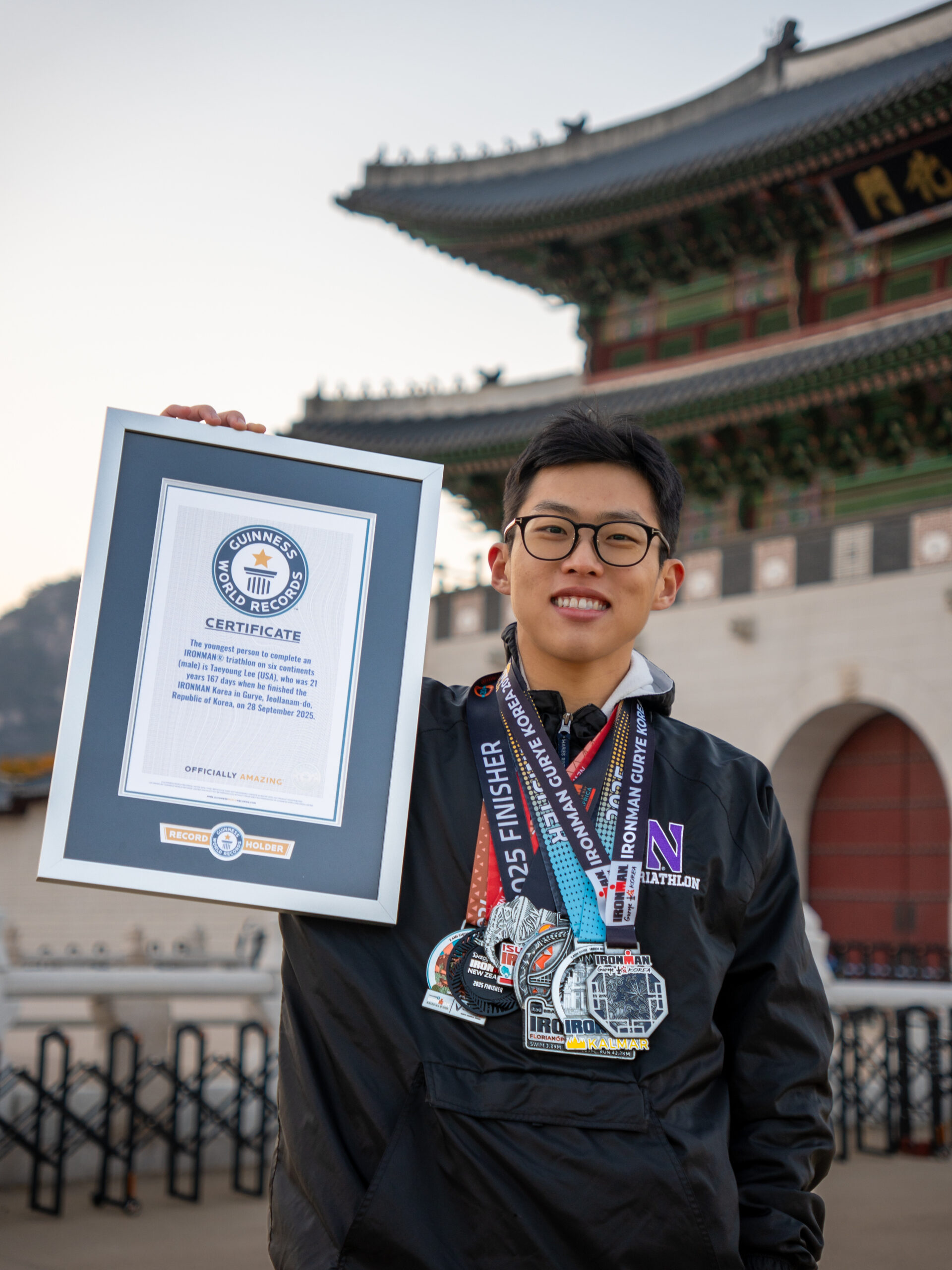
“The youngest person to complete an IRONMAN® triathlon on six continents (male) is Taeyoung Lee (USA), who was 21 years 167 days when he finished the IRONMAN Korea in Gurye, Jeollanam-do, Republic of Korea, on 28 September 2025,” the Guinness World Records site reads. The same words hang on a plaque in Tae’s room, alongside a poster my friends and I made to celebrate.
“The Guinness World Records book was a big thing that I looked at as a child, so the fact that I have one of those records is pretty cool,” Tae said.
Not long ago, another Ironman athlete reached out asking how Tae pulled it off. The athlete assumed Tae grew up wealthy enough to afford the sport’s steep costs. “I told him I’m an immigrant; things weren’t that easy,” Tae said. “But I happened to be lucky, to be in the right situation.”
Luck, he told me, mattered. “Not everybody can probably do what I did because of the circumstances,” he said. “But everyone has their unique advantage somewhere.”
Two years ago, Tae had almost no triathlon experience. What changed wasn’t his resources — it was his mindset.
“Hopefully, people see what I’ve done and how genuinely I had no running or biking experience,” he said. ”I really just had something click in my head.” (To you, the reader, Tae advises: “Find how you are uniquely positioned to do something that can bring value or joy to you. See how you can make the best out of your current situation, and take the small steps to get there, even though it requires being uncomfortable.”)

Image courtesy of Melissa Dai.
With a world record under his belt, Tae’s thinking about his next move. “I don’t want to be complacent,” Tae said. “There’s obviously other stuff I need to learn and grow, and I’m just figuring that out right now.”
That could mean an unofficial Ironman on the seventh continent (Antarctica doesn’t hold an official race). Maybe helping other endurance athletes pursue their dreams. Maybe building a stronger brand on social media. Or branching out to other unfamiliar sports like fencing. (As of late February, he’s gone to several open fencing sessions at Northwestern for practice. I was there. He has a long way to go.)
Whatever he does, another world record could be on the horizon. With Tae, you never know.
One of my first friends at college — who used to stay up late, nap in classrooms and stare at screens nonstop — did this. I never could’ve predicted it, but I wasn’t surprised it happened. Tae’s always been a wildcard.
To close our interviews, I asked for lingering thoughts. He told me, “When I get into something, I get into it really hard.”
Understatement of the century.