Bogotá was not a stranger to me. It was a name I grew up hearing, a place belonging to my grandmother and her sisters and my father and his father and generations of Caros and Nietos and Villegases before me. They seemed, to me, to inhabit the city in its entirety, weaving their way underneath the streets and buildings, all tied back to the same ancient tree. I had only visited Bogotá twice, once when I had just been born, and again when I was barely four years old. But in some part of my blood, I felt as if I was an inheritor of this land; a homeland I did not yet call home. I felt as if I, too, was connected to this tree. But in Bogotá, I was the stranger. I sensed that I had stepped foot into a place so vast that I would never fully fathom it. I would only ever know the corners I found myself in.
But what corners they were! I spent many afternoons in my great-aunt Pati’s art studio. It was a humble little building—concrete walls and only a few windows for natural light—but it became my Renaissance workshop. I painstakingly molded balls of brightly-colored clay into fruits and flowers and overflowing bouquets while Pati and her sister Maria Victoria—known to us as Toti—painted or sketched. We feasted in downtown restaurants: bowls of steaming ajiaco, plates of chicharrones and aguacate and cazuelas de frijoles, tall glasses of jugo de maracuyá, lulo or mango. But my favorite times were driving down the carreras and seeing the mountains, lost in clouds of fog. I had never seen mountains like those in my entire life. They were tall, and lush, and green. They surrounded us on three sides, like some ancient city wall. I could see whole forests and jungles crowding on their surfaces like moss-covered boulders. This was the Bogotá I knew and remembered: a red city, with buildings the color of clay and mountains that scraped the sky.
On some rare occasions, we ventured out of the city, like the day we visited my father’s cousin Luisa. We spent all morning driving down the mountains, through winding roads carved into the dark green jungles of the Andes. The fog was thick, like the clouds themselves had descended, and it drifted through the forest in an opaque, silver mist. We couldn’t see 50 feet ahead of us. The fog surrounded us for miles, and even the mountains in the distance were hiding within it. Only the peaks could be seen, hovering in the sky like floating islands.
But by the time we arrived, the fog had lifted. We had only driven for a few hours, but it seemed we had arrived in an entirely new world. We made a right turn down a narrow dirt lane and found ourselves in the bottom of a small valley. Hidden amongst the oaks and pines dotting the landscape was Luisa’s house.
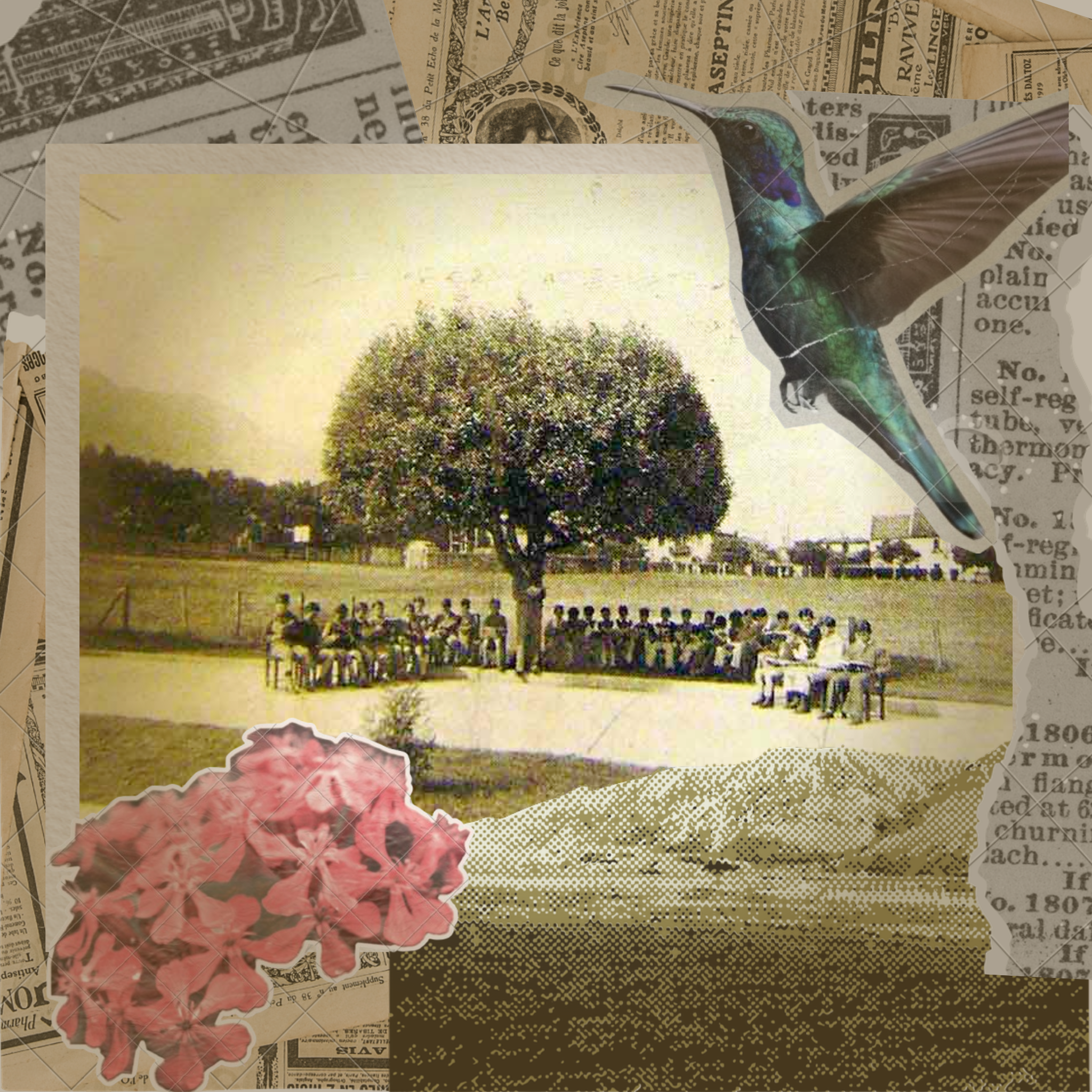
I could’ve sworn we’d ended up in some real-life Eden. The grass was lush and a soft, spring green, like the inside of a ripe avocado. On one side of the house there was a garden, almost like a small meadow. All manner of wildflowers grew there, alongside bushes of soft blue hydrangeas and pink roses. A small patch of strawberries had been planted nearby. Neat rows of red berries and white-and-yellow blossoms sprung out of the soil, swaying in the breeze. Blue-and-purple hummingbirds flitted amongst the flowers, darting in and out of the shade, while a pair of green macaws observed from the grove of trees surrounding the house, blending into the sea of leaves behind them. Towards the back, there were more woods. A grove of palms and deciduous trees tangled up together, with a narrow creek running in between.
I saw Luisa for the first time when we knocked on her front door. She had wispy reddish hair and deep-set brown eyes. She appeared years older than my parents, but there was a brightness to the way she moved and talked, a youthfulness that appeared in glimpses, the way sunlight spills through a forest canopy. A flurry of holas were exchanged, children were admired, and she smiled as she gestured for us to come in.
“I just need to get some things from the kitchen,” she said, darting into a hallway. When she returned, she was holding a wicker basket. “While I am doing that, you can pick some plums for lunch. You will find the trees if you go through the back door.”
Fresh plums, too? The land here was already teeming with life—birds and groves and flowers and forests. I couldn’t fathom the idea of an orchard here too. But when my mother, sister and I ventured out through the back door as instructed, we found a small copse of plum trees, just as Luisa had said. I’d never seen a plum tree before. They looked much like trees I’d seen before—shaped like a pinecone, with branches of green leaves curving inwards towards the top of the tree. The only thing unusual about it was the round purple fruits hanging from its boughs.
My mother lifted me up towards the branch so I could pick the first fruit. I expected it to be firm, to cling to the tree. I was used to the plastic boxes of plums at Costco, cold and damp and perpetually underripe. But the fruit twisted off the branch with ease. I was surprised by the weight of it in my palm, the soft purple skin warm from days in the sun. I could’ve squeezed it open with one hand, or rolled it across the grass without even piercing the skin. It was the consistency of something that is perfectly ripe.
When we returned back to the house, Luisa was waiting with a pair of tongs and a large wooden salad bowl.
“My sister Masayo has a house at the top of the hill,” she said. “You can follow me in your car.”
She led us up the narrowest gravel road I’d ever seen. It felt like if we stopped moving, we’d roll right back down the hill. I could hear the tiny pebbles crunching underneath us as we slowly crawled our way up the hillside. I prayed the tires wouldn’t pop.
Miraculously, we survived the treacherous journey up and parked in a little driveway off the side of the cabin. Masayo’s son was outside grilling steaks, surrounded by a cloud of smoke. Inside the house, Masayo stirred a pot of papas saladas—boiled potatoes covered in a snowcap of salt—on the stove.
We set the basket of plums on the kitchen counter, and started to set the table. A small dinner party had formed, consisting of my family, Luisa, Masayo, Masayo’s husband Miguel and their son. The cabin had not been designed to host eight people for dinner, so the only dining table in sight was a square white table nestled into a corner. It seemed like it was made to seat two people at most. Nonetheless, we managed to squeeze six chairs around it. By the time this nearly-impossible geometry had been solved, Masayo’s son was carrying the finished steaks into the house while Luisa finished tossing a salad.
We laughed as we managed to crowd ourselves around the table and onto the couch nearby. I carefully balanced my plate on my lap and melted as the brightness of the parsley in the carne con chimichurri and the salt-sharpened warmth of the papas saladas hit my tongue. We clinked glasses of water and celebrated our impromptu family reunion. I looked out the living-room window into the Colombian valley below us and silently made my own toast: one to good food, gardens and a homeland I was starting to call home.