
On April 9, barely 24 hours after news broke that the federal government had frozen $790 million in federal funding to Northwestern, the Faculty Senate gathered for what was supposed to be a routine meeting. But as some professors arrived clad in matching purple shirts reading “Don’t Give In — It Won’t Stop Here,” the atmosphere shifted.
Standing before her colleagues, Judith Rosenbaum, a professor at Pritzker School of Law, asked a question that seemed to be on everyone’s mind: “If we don’t stand up in support of academic freedom, where will it end?”
When Peter Barris (McCormick ‘74), chair of the Board of Trustees, entered the room, he was met with boos from faculty. Their homemade agendas urged Barris and the Board to reject the Trump administration’s demands and stand “resolute in protection of academic freedom, First Amendment rights, and the rule of law.”
On March 10, Northwestern was one of many universities to receive an official statement from the Department of Education’s Office for Civil Rights regarding ongoing investigations into antisemitic discrimination and harassment.
Trump’s approach follows a clear pattern. Columbia University was the first to receive an ultimatum from the Trump administration in March: comply with sweeping new demands, or lose $400 million in federal funding. In an early victory for Trump, Columbia capitulated: adopting a formal definition of antisemitism, rewriting its protest policies and considering academic receivership — putting its Middle Eastern Studies Department under external oversight. It also pledged to establish a new internal security unit with the power to remove or arrest people on campus. Today, Columbia’s Department of Middle Eastern, South Asian and African Studies (MESAAS) is being restructured under a newly appointed senior vice provost, installed at the Trump administration’s behest, whose mandate is to ensure a “balanced” curriculum.
Emboldened, the Trump administration widened its campaign. The federal government wiped $175 million off the University of Pennsylvania’s books, citing, in part, the university’s decision to allow transgender athlete Lia Thomas to compete on the women’s swim team. Then came Brown: $510 million. Harvard, the highest-profile target, lost $2.2 billion in grants and $60 million in contracts. Cornell: $1 billion. And on April 8, Northwestern got word from the media that $790 million is on the line.
Now Northwestern faces a stark choice: comply with shifting federal mandates that may contradict institutional values — or forfeit nearly $800 million in annual federal support that underwrites drug trials, cancer research, physical therapy labs, clinics and other cutting-edge scientific research.
Since the funding freeze, Northwestern has received 98 stop-work orders for grants from the federal government. Potential funding for projects like the world’s smallest pacemaker and research on Alzheimer’s disease is at stake. The University also received 51 grant terminations and frozen or cancelled grants from other federally funded agencies like the National Science Foundation.
In a May 1 email, President Schill reminded the Northwestern community of the University’s promise to support research affected by stop-work orders, though many wonder what this will look like and how faculty and students will be affected by financial restructuring.
Northwestern students have begun to feel the effects. The Summer Internship Grant Program accepted fewer students than usual due to budget reductions. The University has discontinued other programs, such as the San Francisco campus.
On April 22, President Schill joined more than 200 academic leaders in signing a letter denouncing what they described as the Trump administration’s “overreach” into institutions of higher education. Harvard President Alan Garber added his name to the statement just a day after his university filed a lawsuit against the Trump administration in response to its threats to withdraw billions in federal funding.
Northwestern has drawn congressional scrutiny since a nationwide wave of pro-Palestinian encampments reached Evanston last April. In May 2024, the House Committee on Education and the Workforce grilled university presidents, including Schill, over allegations of campus antisemitism. Schill pledged “on behalf of the University to take decisive actions to combat antisemitism and ensure that Jewish students, faculty and staff would experience a safe learning environment,” according to a University statement.
Schill has since updated the Student Code of Conduct and the Demonstration Policy, taken disciplinary action against protestors at The Rock and implemented new antisemitism trainings. A progress report on the University’s efforts tout an 88% decrease in antisemitism from November 2023 to November 2024.
Yet, the federal inquisition continues.
Faculty take a stand
As the faculty senate meeting progressed, Greg Beitel, associate professor of Molecular Biosciences, wondered if taking an official stance could alienate the University and further jeopardize vital research funding.
“What are you betting here?” he asked.
After deliberation, the Senate voted to endorse a statement calling on the University to stand up to federal demands — a victory for advocates of academic autonomy.
Faculty Senate President-Elect and professor of Political Science Ian Hurd expresses cautious optimism, impressed by emerging solidarity between faculty and administration.
“I’m glad to see the administration standing up strongly for the two basic principles of what a university is,” Hurd says. “First, a place of learning and teaching, where scholarship is independent of government influence, and second, a place of research, where the motivating question is always trying to understand the truth of a situation.”
Luis A. Nunes Amaral, professor of Engineering Sciences and Applied Mathematics, who grew up under Portugal’s fascist dictatorship, calls the federal scrutiny an attack on academic pluralism. Amaral says the Trump administration is targeting institutions it views as too “woke.”
Nitasha Tamar Sharma, professor of African American and Asian American Studies, offers a perspective rooted in history. Sharma sees the federal scrutiny through the lens of a nation’s complicated reckoning with its own shifting demographics.
“It’s really kind of a response to Obama,” Sharma says. “It’s a response to Black Lives Matter. It’s a response to increasing diversity.”
Yet even as faculty voice concerns, they remain aware of the material stakes. Northwestern received $519.6 million in National Institutes of Health (NIH) grants for the 2024-25 academic year, funding now on the line. As the Faculty Senate meeting adjourned, the undercurrent of resistance remained. April 9 was not an isolated event. The fight over academic freedom at Northwestern was just beginning.
A day of action
On April 17, faculty and students at Northwestern organized a Day of Action for Higher Education, joining a national movement that spanned more than 150 campuses. Against a backdrop of federal investigations into antisemitism, threatened funding freezes and visa uncertainty for international students, participants called on the University to resist mounting federal pressure.
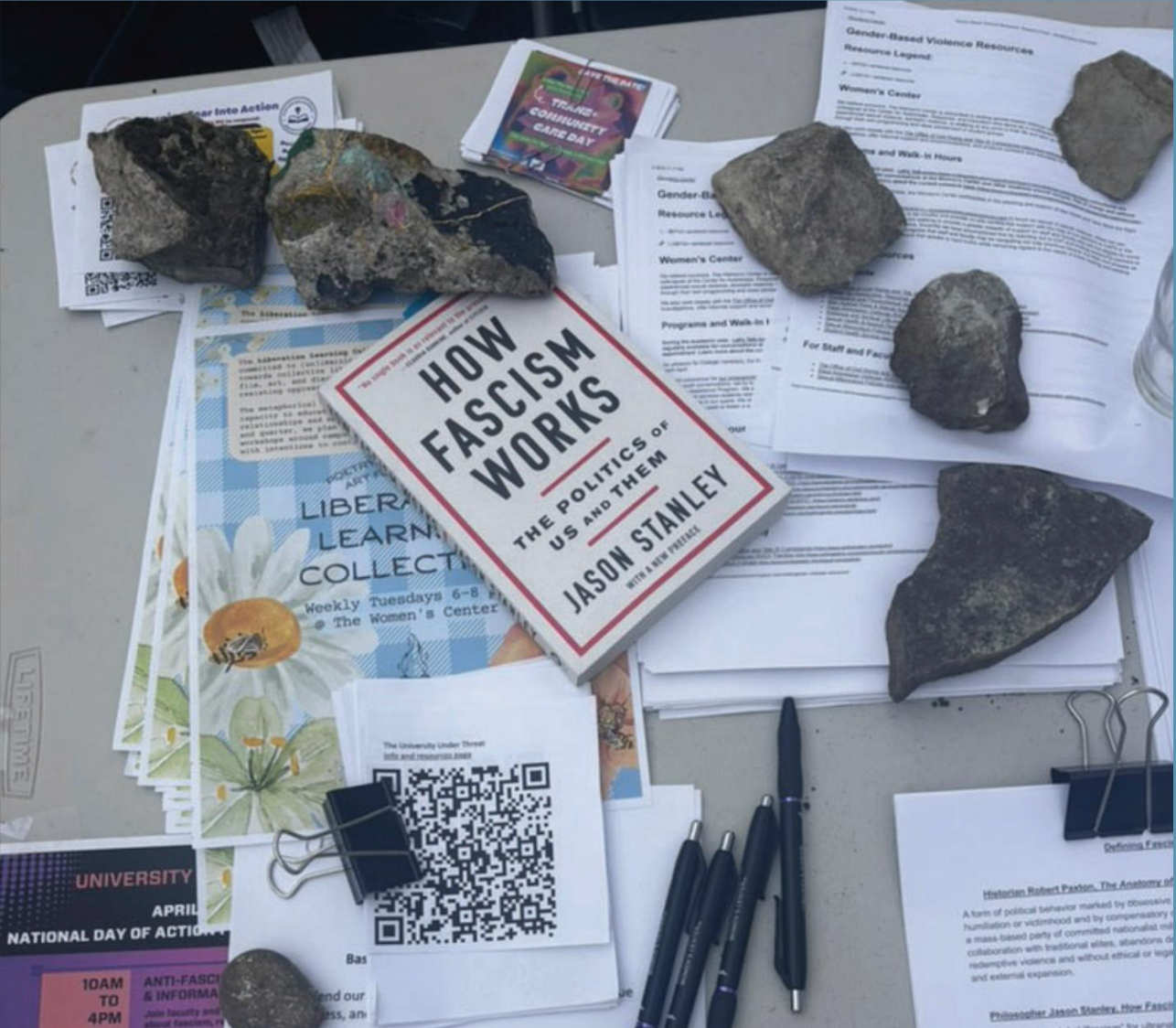
The day unfolded across campus: white fold-up tables staffed with volunteers, flyers advertising “anti-fascism office hours” and a series of teach-ins hosted by faculty from multiple departments. Amaral and professor of Political Science Jacqueline Stevens led one such session, examining the influence and operations of Northwestern’s Board of Trustees. Amaral graphed what he saw as Board of Trustees members’ personal careers creating a conflict of interest with the University. Amaral’s report takes issue with the large size of Northwestern’s Board of Trustees relative to peer institutions, lack of gender diversity on the Board and over-representation of members with a background in consulting or finance rather than other expertises.
Many at the Day of Action called on the Board of Trustees to consider using the endowment — a pool of funds typically built through donations and invested to sustain the institution’s mission and operation in perpetuity — to create financial flexibility and avoid capitulating to federal demands. Professor at Feinberg School of Medicine Peter Sporn says the University should find financial workarounds to protect its core mission.
“If it means dipping into the endowment — because we don’t get those research funds — to be true to the values of the institution, to be true to the values or the principles upon which it was supposedly founded, that’s required,” Sporn says. “And if we abandon those values to protect an endowment, and it’s used for other purposes, what are we saving?”
According to the April 9 Faculty Senate meeting minutes, Barris said the administration and Board of Trustees are considering all options to finance university operations and research. According to the minutes, “Drawing additional funds from the endowment is the last place they want to go, but it is not off the table.”
Most universities draw about 5% annually from their endowments.
“If you go much above that, you’re probably going to erode the real value of the endowment. If you go much below then it’s unfair to the current faculty, students and staff,” said former Northwestern president Morton Schapiro in an interview with The Wall Street Journal.
At Northwestern, that payout accounted for roughly 23% of the University’s total operating budget in the 2024 fiscal year, amounting to $756 million. According to the University’s Annual Endowment Report, Northwestern’s endowment is managed by the Investment Committee of the Board of Trustees.
Since 2000, Northwestern’s endowment has grown more than fourfold. That growth, driven largely by a strong equity market performance, has offered a sense of financial security — but also underscores a widening divide. Institutions without such resources are more vulnerable to market volatility and must depend more heavily on undergraduate tuition, often becoming more need-aware in the process.
At the Day of Action at Deering Meadow, a press conference held by the Northwestern University Graduate Workers (NUGW) and Students Organizing for Labor Rights responded to growing concerns over financial pressures facing institutions of higher education.
In the midst of the event, the University announced it would use alternative sources to continue funding research projects affected by federal stop-work orders. A May 1 communication from Schill emphasized the University’s decision to support research subject to stop-work orders, most of which have been for research projects funded by the Department of Defense. Research grants already terminated by the NIH were left in limbo.
“However, this commitment places significant financial stress on the University and is not a permanent solution,” Schill wrote.
Peter Cummings, a fourth-year psychology Ph.D. candidate and chief steward of NUGW, expressed hesitancy about what the University would choose to prioritize.
“Northwestern is opening up funding for Defense and the military, but leaving research in defense of queer and trans lives in the dark,” Cummings said.
Dr. Brian Mustanski is the director of the Institute for Sexual and Gender Minority Health and Wellbeing at Feinberg School of Medicine. Mustanski built the lab into a nationally recognized research center, only to see it lose two major grants — one focused on HIV and other negative health outcomes among the young queer male population; the other on HIV prevention and treatment strategies. According to NBC News, Mustanski’s two grants are just a small fraction of more than 270 NIH grants, totaling a minimum of $125 million, now canceled.
Outside the formal Day of Action, faculty members continue mobilizing. Professor of Psychology Michael Kraus emphasizes that while the potential loss of research funding is serious, the real stakes are human: the possibility of international students losing their visas or their ability to safely continue their education. Students in Kraus’s lab helped organize a “Know Your Rights” workshop in response to mounting threats against their research and the international students who contribute to it.
“If you’re actually concerned with discrimination, you would be concerned with the mistreatment of students,” Kraus says. “Students are terrorized by these conditions.”
Where do we go from here?
The Trump administration has yet to issue formal demands to Northwestern to restore its federal funding. The University remains under Title VI investigations by Congress. The National Science Foundation has canceled grants for at least five Northwestern projects. The School of Communication, Medill and Bienen have quietly scrubbed DEI pages and renamed administrative positions.
On April 28, House Education and Workforce Committee Chairman Tim Walberg (R-MI) issued a formal request for a transcribed interview with Schill, pressing for answers on the University’s response to antisemitic incidents on campus. Walberg’s request cites recent acts of vandalism during the Passover holiday, including graffiti and flyers described as “hate-filled” found outside University Hall and Kresge Centennial Hall on April 14. In the letter, Walberg accuses Northwestern of failing to follow through on commitments made during Schill’s congressional testimony nearly a year ago, writing that the Committee “has not seen your commitments to discipline, enforcement, and security come to satisfactory fruition.”
Outside Kresge, the graffiti has been scrubbed away. Inside, the classrooms are quiet, almost ordinary. But the questions remain: what comes next, where do we go from here and who decides? As Walberg’s letter lands on Schill’s desk, it joins a growing stack of requests, rebukes and expectations. The headlines continue to shift fast. Protests may give ways to subpoenas; scrutiny across the political spectrum may replace discourse.
If these past few months have revealed anything, it’s that the University is no longer just a sanctuary for scholarship; it is a battleground in a larger national debate about the role of higher education in democracy.
Sporn says the Northwestern community needs to band together to confront the impact of federal funding cuts.
“Nobody will save us,” Sporn says, “Unless we fight together to save ourselves.”
Print design by Ilse Von Heimburg.