
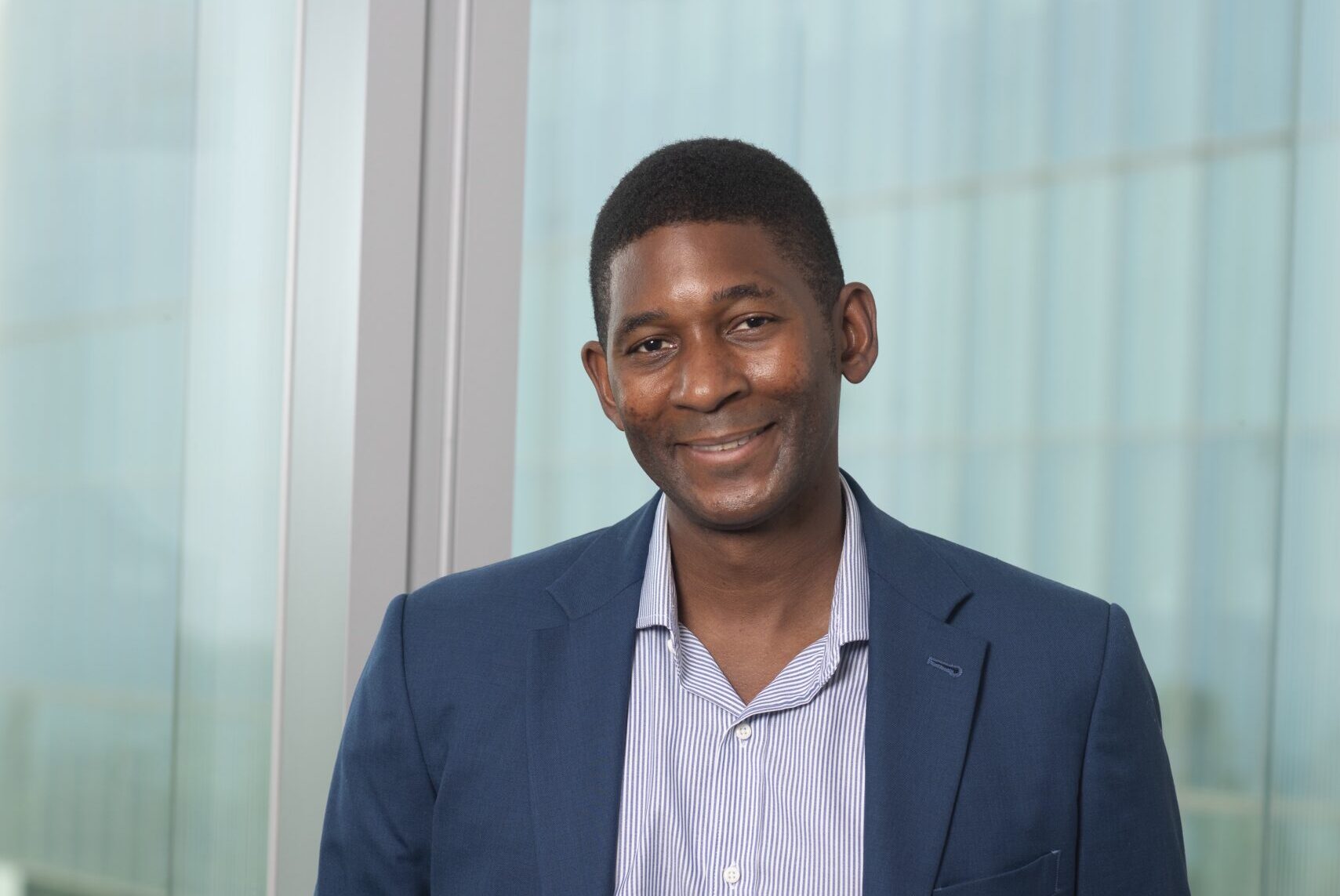
In 2023, Kirabo Jackson left the hallowed halls of Northwestern’s School of Education and Social Policy for somewhere a little more high-profile: the White House. During his time as a member of the Biden Administration’s Council of Economic Advisers, Jackson gained new perspectives on policy making and navigating uncertainty. This spring, North by Northwestern sat down with the professor to learn more about his experiences.
What challenges did you face adapting from academia to direct policymaking?
The administration brought me in largely because I had expertise in the areas of labor economics and education policy. After the pandemic, the administration was thinking about the decline in test scores and deterioration in mental health among students.
I had the expertise and was happy to work and help them achieve their policy goals in the most economically sound way. I had to change my orientation a little on certain topics as I wouldn’t say that I agreed with everything the administration was doing.
Why do you think there was a disconnect between economic indicators and public sentiment under the Biden administration?
That’s an interesting question I’ve been asked many times. I can answer it more honestly now because I’m no longer representing the White House.
The Biden administration struggled to effectively communicate economic wins because the benefits were often gradual while the pain points, like inflation, were immediate and tangible. It’s a reminder that economic policy success isn’t just about the numbers but about how people experience their day-to-day financial lives.
COVID was a disruptive time. It exposed many Americans and many people across the world to the fact that things are not always as stable as they seem. We were going about our lives just regularly and, suddenly, something drastically changed. Having said that, the economy under Biden was growing strong. We had a GDP growth of, like, 3.4% in 2024.
Despite statistical improvements in wage growth, especially for lower-income workers, people’s lived experiences often differed from what the data suggested. Several factors contributed to this disconnect.
First, inflation hit hard during the post-pandemic recovery. Even with wage growth, many families saw their grocery and housing costs rise significantly, which eroded purchasing power and created financial stress despite nominal income gains.
Second, these economic improvements were happening against a backdrop of pandemic trauma and political polarization. When people are anxious or divided, positive economic news often doesn’t resonate the same way.
Third, economic indicators are averages that can mask individual experiences. A family facing a medical emergency or housing crisis might not feel the benefits of broader wage growth when facing immediate financial pressures.
You have been an expert witness in cases determining whether school funding is constitutional. How do you make sense of current changes regarding federal funding for education?
I’ve been thinking a lot about the implications from multiple angles. When these things happen, the first reaction is, “This sounds very drastic. What does it mean?”
One of the first things I try to do is think, “What does the federal government do? How much money does the federal government control? What is the role of the federal government in the K-12 system and in higher education as well?” That helps ground yourself to get a sense of possible scenarios.
Title I, which provides federal money for lower-income kids, came into existence under the Elementary and Secondary Education Act. That predates the establishment of the Department of Education. We must provide money for students with disabilities. That also is by statute, not something the president can just decide to not fund.
If that money were to disappear, low-income kids and students with disabilities would be disproportionately affected. Affluent neighborhoods wouldn’t feel it as much because they don’t receive as much federal funding.
To put this in perspective: if all federal education dollars were eliminated, research estimates suggest the overall high school graduation rate could fall by 3 or 4 percentage points. The college-going rate would likely fall by about 5 percentage points. That’s a significant impact on our future workforce and productivity decades down the line.
The silver lining is that because most education happens at the state or local level, we can lean on state legislators, policymakers and local community leaders to step up. It will be painful for some communities, but if we focus locally, we can weather the storm.
With Northwestern’s hefty price tag, is a Northwestern degree still a sound investment?
The good news is that the Northwestern brand is strong, and your education will be valuable.
There’s been debate in popular media suggesting education’s value isn’t what it used to be. That’s simply not true. People are less likely to pursue two-year degrees at community colleges, but enrollment in four-year institutions remains strong.
Looking at returns on education: college graduates earn 40-50% more than those with just high school diplomas. Those returns remain substantial, and I don’t see that changing anytime soon.
Regarding the future, I don’t think it’s feasible for us to move back to an economy where the middle class is sustained by doing things with our hands. That’s not how we make things anymore. Instead we’re an economy where we use technology to a great extent.
I suspect if we’re able to get more manufacturing back to the U.S., we’re going to have manufacturing jobs that still require skills because it’s going to be manufacturing jobs that are using technology. It’s not necessarily going to be manual labor.
As we enter this new terrain, what economic survival skills should young people be developing?
One of the benefits of having a Northwestern degree, or any sort of four-year degree, particularly one from an T10 institution is it provides a broad set of skills. Not just in terms of knowing a particular topic area, but it teaches you not just what to know, but also how to think about things, how to reason. It’s those problem-solving skills, those reasoning skills that allow workers to be more nimble.
Number two: make yourself indispensable. Make sure that you’re at a position where if they tried to get rid of you, they would have to jump through many hoops.
Number three: keep up with the times. Get up to speed on how people are using AI. I think that’s going to be really helpful. For young people, I think that’s going to be second nature, but for dinosaurs like me, we have to sort of pick it up and learn it.
The best way to navigate economic uncertainty is always to develop adaptable skills. Northwestern graduates will be well-positioned to weather these changes better than most.
Print design by Adelle Rubinchik.