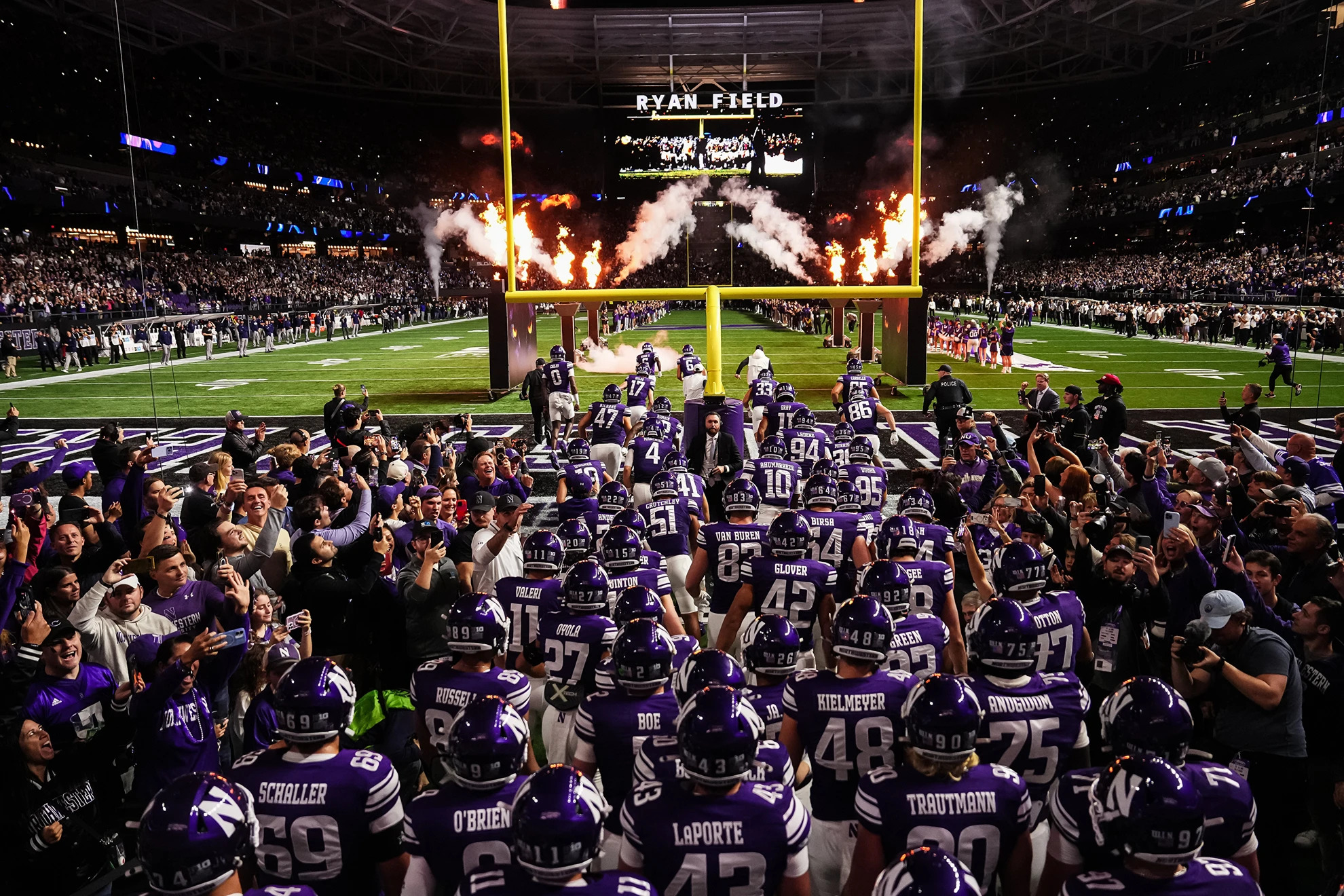
On Oct. 2, the new Ryan Field opened as the home of Northwestern football, where the Wildcats won 34-13 over Penn State in a Friday night primetime game. The team’s dominant start to the season (5-1, 2-1 B1G) has catapulted them into the AP Top 25 for the first time since the 2020 season.
This success on the field may soon show up somewhere else: the admissions office.
Researchers have studied the link between athletic success and college applications for decades. Earlier research from Illinois State University found that when a football team’s winning percentage increased by more than .250, applications rose by an average of 6.1%. A subsequent study by the same researchers examined the impact of individual athletic success, finding that schools saw a 6.59% increase in applicants the year after one of their football players finished in the top five of Heisman Trophy voting.
Northwestern has experienced this effect before. After the 1995 season where the Wildcats won the Big Ten Championship and reached the Rose Bowl, applications to the University rose 21%, according to research by Harvard Business School professor Doug Chung.
Northwestern, a founding member of the Big Ten Conference, has always leveraged sports as part of its admissions marketing, yet its lackluster performance in football recently has caused the school to fall out of widespread competition for the most sports obsessed students. Now, the new Ryan Field has increased hope that Northwestern will attract more students who prioritize their school’s athletics.
Medill first-year Mateus Hertz-Bird said Northwestern’s athletic programs influenced him to choose Northwestern over the University of Pennsylvania, where he was also accepted. Hertz-Bird said sports “play a huge role in the culture of the school” and described rooting for Northwestern’s athletic teams as an outlet to destress.
Hertz-Bird particularly mentioned the new Ryan Field. He said the environment at the first game was “amazing” and that he “hopes it will drive more interest in the school.”
But only select sports carry so much weight.
Football and men’s basketball, the sports with the largest national television audiences, have driven nearly every well known case of a sports related application boom. Georgetown University, for example, saw applications rise 45% between 1983 and 1986, when Patrick Ewing led the men’s basketball team to three Final Fours.
Chung also found that athletic success attracts not only more applicants but also draws interest from high achieving students, allowing schools to become more selective. However, Chung found the effect works like advertising: it fades over time unless a team keeps winning. Whether a stadium like the new Ryan Field becomes a lasting recruiting tool may depend on whether the Wildcats can stay in the Top 25 and deliver a memorable football season.
Some students, however, don’t think sports had a high impact on their choice to attend Northwestern. Weinberg first-year Grace Lu said she was “disappointed” when she found out Northwestern was a Division I school, but that such displeasure only stems from lack of excitement to attend football games. Lu did say, though, that the atmosphere of the new Ryan Field was “electric.”
The new Ryan Field and Northwestern’s increased athletic prominence represent a turning point for the institution, one that could change the number and type of students who choose to apply.
The results of this impact will become clear in mid-December, when Northwestern’s Office of Undergraduate Admissions releases both the early decision results and the number of applications received.