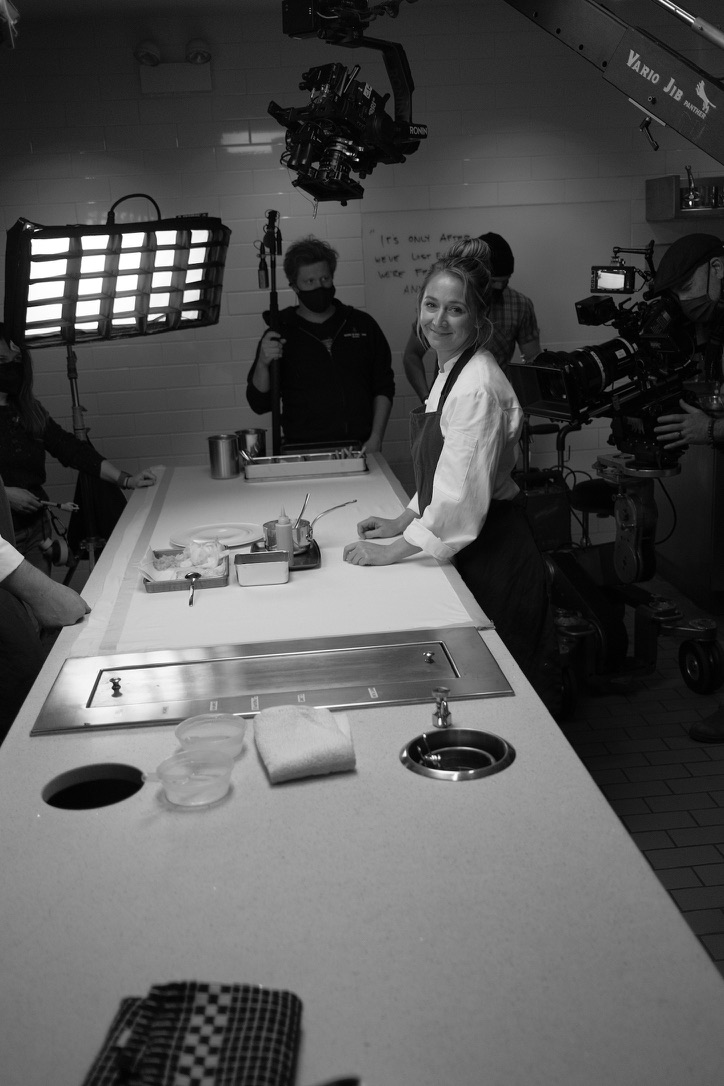
Few terms are as recognizable in food culture as “Yes, chef,” the now-iconic phrase popularized by the hit Emmy Award-winning series The Bear. Behind the show’s authentic portrayal of life in a professional kitchen is Courtney “Coco” Storer, the culinary producer whose work helped bring its fictional restaurant to life.
From choreographing chaotic scenes of service to ensuring that every dish looks and feels true to the restaurant world, Storer played a key role in shaping the show’s authenticity. Her work bridges the gap between television and real-life restaurant culture, giving viewers an intimate look at the discipline, creativity and pressure that define the culinary industry.
Now, Storer’s influence extends beyond the kitchen sets of The Bear, as audiences and aspiring chefs alike have become increasingly fascinated by the craft behind the show.
During our conversation with Storer, we got the chance to discuss her work on The Bear, her background, the culinary inspirations behind the show, Chicago food culture and the behind-the-scenes details that made its kitchen feel so real.
This interview has been edited and condensed for clarity.
What was your earliest relationship with food like, and what sparked your interest in the culinary world?
There are so many things. I’m a very visual person, and I have a pretty vivid imagination. One of my earliest memories is wondering why Froot Loops came in different colors. I know that sounds weird, but I was fascinated by the mystery of food from a young age.
I would say it started with Froot Loops, and then there was a commercial where someone pulled apart a mozzarella stick. I remember thinking, “Whoa, what is this magical world?” I’ve always equated food with magic.
I was fascinated by restaurants very early in life. The first restaurant I ever went to was a place called Sunny’s, which I actually ended up working at when I was about 15. Every year, it was where my family went to celebrate special occasions. I always had the most fun at restaurants.
For most kids, it might have been Chuck E. Cheese. I was looking for something different. I wanted to go to a Chinese restaurant and get in the kitchen. I just wanted to see behind the scenes. I remember being really young and constantly asking my mom if I could go to the bathroom, only to go look into the kitchen.
What is your relationship with Chicago and its food culture? What was it like growing up here?
I say this a lot, but I think Chicago is one of the greatest food cities in general. It’s not just about the food; it’s really about the magic of the people within the hospitality industry. Hospitality in Chicago set me up for success in my career as a food professional.
I think that started because I saw such a strong love for food in the restaurants I visited. On Devon Avenue, for example, there are incredible restaurants where you can find all sorts of South Asian food. Throughout Chicago, you have incredible Ethiopian food, pierogies and so many other options.
I think I was exposed to a lot of different types of food as a kid. Rather than just experiencing the food of my Italian American family, I was constantly exposed to different restaurants and bakeries. It really impacted my palate and helped me understand just how much delicious food from different cultures is out there, especially in the Chicagoland area.
What did your professional journey look like before working on The Bear? How did you get into the food industry, and what was that progression like?
I would say my journey was centered around perseverance and a love for food because it certainly wasn’t easy. The food industry is really tough, and you get out of it what you put into it.
A lot of people think The Bear just came around, my brother created it, and I hopped in. But the truth is, I wouldn’t have been prepared for that job without all the hard work and experience I developed over time.
I’ve been working in restaurants since I was 15. Sunny’s was my first job, but from there I moved on to working at a smoothie shop, becoming a front-of-house manager, working as a host and bartending. All of those experiences brought me closer to food.
I also had restaurant jobs alongside my regular nine-to-five career. A lot of people don’t know that I pursued human resources after college. I love working with people, so I worked in HR at UPS, where I developed a certain reputation and eventually moved on to Whole Foods. That brought me closer to the food industry, combining human resources with my interest in food. Eventually, I realized I wanted to pursue food exclusively, which is why I went to culinary school and became a chef.

Every job I had helped me become a better chef. Working in logistics at UPS, understanding grocery operations at Whole Foods and learning about farming, sustainability and healthy eating all contributed to the chef I am today. I always say that every job has mattered.
Looking back on that time in your life, what is one lesson you took away from each major era? What did each experience teach you?
Early on in restaurants, I learned the power of teamwork. I was a soccer player, so I already understood what it meant to be part of a team. But working in restaurants showed me how much every person matters. You’re only as strong as your bench, and you need each other.
My first experience in a restaurant was as a server, and I learned how important teamwork, communication and professionalism are. It also pushed me outside my comfort zone because I had to engage with customers and really develop my people skills.
At Whole Foods, I was exposed to the behind-the-scenes operations of so many different parts of the food industry. From the cheese counter to the seafood department, meat department, produce section and prepared foods, I began to understand all the different facets that make up the food business. But I also realized how much more there was to learn.
When I went to culinary school, I quickly learned just how much there is to know as a chef. Culinary school taught me to take risks because it reinforced that the risk was worth it. When I first set foot in culinary school, I knew I was in the right place. My instincts told me that.
Then I moved to Europe by myself, which was really scary. My first day working in kitchens in Paris was awful. I was terrible. It was like Ratatouille times ten. I was Remy sliding all over the floor, knocking into things and cutting myself.
I kept reminding myself: You’re bad until you’re good.
Working in restaurants taught me that you need endurance. You have to believe in yourself and build the stamina to become a better cook. All those different experiences across different fields ultimately taught me not to give up when things got hard.
Tell me a little bit about your journey to culinary school.
I always tell people, especially people your age, that it’s okay not to have a complete understanding of what you’re going to do. You’ve made it to college, and that’s a success in and of itself. What you learn there might surprise you. You might realize you want to pursue exactly what you originally planned, or you might discover something completely different.
My path didn’t look like that, but my undergraduate experience was incredibly significant to my journey.
In college, I watched Rachael Ray and tons of cooking content on Food Network. We didn’t have Instagram and all of those platforms back then, but that content got me thinking about food.
When I started working at Whole Foods, I was around food constantly. I had an experience where the prepared foods department was making salmon. They were cooking all the time, and I would eat the salmon for lunch. One day, I went into the kitchen and started talking to them. I asked how everything was going and how their benefits were, and then I started telling them they were overcooking the salmon and suggesting different ways to prepare it.
The store manager came over and said, “You seem to be telling people how to cook everything. What’s going on?”
I didn’t really understand what he meant. People had always told me I was bossy. But he said, “No, you have a passion for food. Why don’t you give it a try? There’s a cooking school down the block. Go check it out.”
I listened to him, and it became an incredible fork in the road for me. He recognized my passion and encouraged me to pursue it.
Going back to school in my late twenties while working a day job was a lot. I was working nine to five and attending culinary school at night.
I also had a culinary professor who became a huge mentor to me. He was incredibly strict, and he once asked what my plan was after culinary school. I told him I didn’t know exactly what I wanted to do, but I wanted to get my butt kicked somewhere. I wanted to go somewhere that would really challenge me.
He told me to go to Paris. I thought he was crazy. I told him I couldn’t afford it, but he said, “Find your way there. You’ll find your way back. Pay for one flight there.”
And he was right.
That’s why having good mentors is so important. Without people pushing me, I might have been too scared to take that leap.

Now let’s transition to The Bear. What does being a culinary producer actually look like, and what was that experience like for you?
The Bear is interesting because culinary producer isn’t a job you see very often. It’s a bit of a hustle.
Culinary production involves looking at things from both a macro and micro perspective. I worked with my brother Chris, who created The Bear, and helped communicate real-life kitchen experiences to the writing team.
A big part of the job happens behind the scenes. It’s about making sure the story is accurate before the scripts go out to the actors. The slang and terminology need to make sense, whether we’re talking about menu planning or describing an event in a script, like making an omelet.
That means everything from conveying the steps of a particular cooking technique to explaining those processes to the cast.
But there’s also the on-site work. The cast trained with me in my kitchen here in Los Angeles. We worked specifically on the journey each character is taking and what they need to learn.
Then there’s the actual work on set. I’m not only helping the cast learn how to do things, but also choreographing certain movements so that the restaurant feels real.
That includes everything from how an actor carries a tray to how they use a knife, sauté a piece of wagyu, sear something or operate a particular piece of equipment. It’s also about how they interact with each other.
Someone saying “behind” or “chef” is one thing, but how they use their voice and when they say those things in a kitchen are important. All of that requires training.
We wanted the show to feel real, so we implemented those details throughout the production.
When the cast trained with me, we often operated with a chain of command, just as you would in an actual kitchen. We made sure the actors understood how to prep ingredients, chop onions, set up a station, break down a station and interact with one another.
You need to show the dynamics that exist so vibrantly in real restaurants. If you have a camera in a kitchen, how do you illustrate that there’s so much happening beyond two people simply saying “Yes, chef”?
It has to feel real, and we worked hard to make it that way.
A big part of my job was using real food, making sure the kitchen was operating properly and ensuring the staff was dressed appropriately. We wanted the actors to smell the kitchen, feel it and engage all five of their senses so that their acting would feel more natural in those environments.
Was there a particular scene, dish or moment that was especially difficult to produce? And do you have a favorite dish?
Oh my God, there were so many!
The most difficult was the violet dish that comes off Marcus’ station in season three because it had so many components. It was a case of more, more, more, which is exactly what a lot of chefs do. People often go for complexity rather than simplicity to illustrate that something is good.
That’s part of Marcus’s journey. You see him go from making simple doughnuts and chocolate cake to creating something much more complicated, and eventually toward a hybrid of both. How can you make something simple and delicious while still using your skill set without overcomplicating it?
The violet had around 20 components. We had to make it every day, train the cast and deal with technical challenges. For example, the temperature could cause the sugar to soften. There were just so many technically difficult aspects to that dish.

My favorite dish was probably the cannoli we developed. It was a savory cannoli, and I got to work closely with my brother Chris to discuss what we were trying to communicate through that story.
The cannoli represents a new way of creating a corrective memory around food. Something that was once a painful memory for Carmy becomes something different when Marcus offers him another experience. He’s essentially saying that this can be something positive for you, a corrective way of turning a bad memory into something good.
If you had a full day to eat your way around the city, where would you go for breakfast, lunch and dinner?
I would probably start at Doma for breakfast. I’d go to Portillo’s for lunch. Honestly, Portillo’s is accessible, and that’s what we’re looking for. We’re looking for something we can get for $20, right?
For a cute dinner, I would go to Dimmi Dimmi in Lincoln Park, I think. It’s a really great Italian restaurant that I love.
We spoke a little bit about the college journey, but what piece of advice would you give to college students?
I would say to change your environment as much as you can.
It’s great to have a familiar environment, but I always think about what else might be out there for your creative brain. If you’re studying at Northwestern, where else can you go that might enrich you?
Sometimes you don’t have the budget to fly across the country. That’s the beauty of eating different types of food: it gives you an understanding of different ingredients, people and cultures. The more you expose yourself to those experiences, the more worldly you become. You develop a better understanding of other people and become a more well-rounded person.
Before I had the resources to travel, I traveled through restaurants until I could afford to do it myself.
I also think working with different teams is incredibly important. Sometimes changing your environment gives you that opportunity. If one environment isn’t as enriching, allow yourself to find another one where you can make better friends and meet better coworkers.
Maybe you don’t hit it off with everyone in one class, but you might find your people at work. It’s nice to have different places where you can find a sense of belonging and become part of a team.
Even if it’s just a part-time situation, give yourself different environments in which to discover yourself.
I know college is hard, and you might not have a lot of time. But even if you take one day to volunteer somewhere else, it’s good to get yourself out of your bubble.
Burst your bubble.