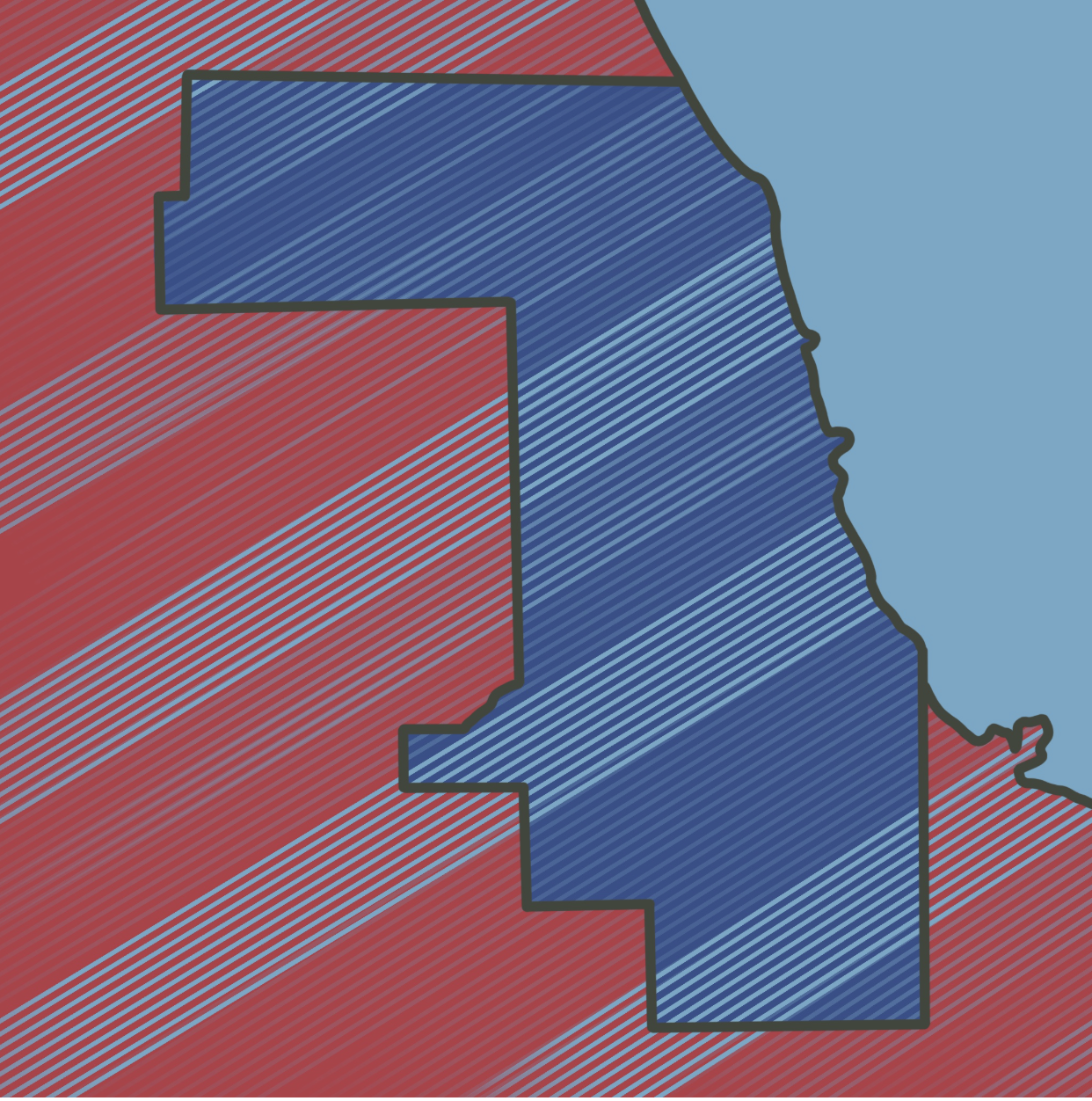
The New Illinois Movement doesn’t use the word “secession” to describe its plan to separate from Cook County.
“It’s too loaded,” August Block, an organizer of the New Illinois Movement, said. “We prefer division as our talking point. So we don’t advocate secession, but to your point, that’s sort of historically correct.”
As an organizer for the New Illinois Movement, Block is advocating for a radical development: separating Chicago and Cook County from the rest of Illinois’ 101 other counties through the same constitutional article that created West Virginia during the Civil War.
The New Illinois Movement aims to legally separate Illinois’ 101 non-Cook counties from Chicago to create a state that better serves downstate and rural communities. Advocates for the movement point to Illinois’ gerrymandering, Chicago’s political dominance in the Illinois General Assembly and Cook County costs flowing downstate.
The movement would divide Illinois through Article IV, Section 3 of the U.S. Constitution. The Illinois General Assembly and the U.S. Congress would need to approve the request.
Block lives in Bureau County, which dedicates over 93% of its land to agriculture and has, by Block’s estimation, seven traffic lights. Block works as a cattleman and truck driver and represents the 17th District of Bureau County on the county board. He is also Bureau’s primary New Illinois committee contact.
Block argues that the differences between Chicago and downstate Illinois cut deeper than legislative gridlock and partisan feuds.
“Because of the way the country was settled, most settlers moved east to west,” Block said. “So you’ve got this very strong Yankee influence in the center of the state, and, a little north, you’ve got this Hoosier influence in the southern part of the state. Chicago had a very cosmopolitan settlement, which doesn’t really align with either of those two groups. So, historically, that’s what I theorized caused a lot of friction.”
A group of 11 Illinois counties passed nonbinding advisory “separation referendums” to open discussions over splitting with Cook County in the recent midterm elections, joining 33 others that have passed them in prior years. No county has rejected it so far. The vote passed with a 79.6% vote in favor in Hamilton County, a rural southern Illinois county with a population just under 8,000.
These results follow a national “blue wave” that saw the Democratic Party earn sweeping gains both nationally and in state legislatures in the midterms. Democrats expanded their majorities in the state Senate and House of Representatives. As of Nov. 8, Democrats led 45-13 in the Illinois Senate and 83-32 in the Illinois House.
Block pointed to federal gerrymandering and uncompetitive races as a major point of discontent. However, Gwen Pepin, the communications director at the Democratic Party of Illinois, said that Cook County and the rest of Illinois can coexist despite the Democrats’ historical dominance.
“A lot of times, people are frustrated about the same things, no matter where you are geographically in the state,” Pepin said. “Someone in Chicago is frustrated by cost of living, and a farmer in a southern Illinois town is also frustrated about cost of living. So I know it may sound corny, but we do have a lot in common, and I think our party can remind folks of that.”
“We may say it differently, but everyone’s just trying to keep their head above water,” Pepin said.
Despite national Democratic gains, momentum in rural Illinois remains difficult. Northwestern political science professor Reuel Rogers said that rural voters distrust “big government” because of perceived unequal resource sharing.
“Their understanding or perception is that they’re getting the short end of the stick,” Rogers said. “They’re getting a bum deal because the assumption is that people living in cities are doing better than they are. Even if they do recognize that people living in poor neighborhoods and inner-ring suburbs, for instance, are struggling, it’s because they mismanage government resources.”
Although downstate residents often argue that rural tax dollars prop up mismanaged Chicago governments, the opposite is actually true. A 2016 study by the Paul Simon Public Policy Institute Fund found that southern Illinois received $2.88 in state funding for every $1 in taxes it spends, and downstate as a whole received $1.70. Cook County received 90 cents, implying money streams out of Cook County rather than vice versa.
Despite the referendums passed in nearly half of Illinois’ counties, there are few state or federal legislative partners willing to get the ball rolling for either annexation into neighboring Indiana or the carving out of an entire new state. Despite the long pathway to statehood, Block said that political activism and advisory referendums remain important.
“We as citizens owe it to our neighbors and children and all that good stuff to be aware and be involved,” Block said. “That’s enough. To be publicly advocating for good policies and good reforms is entirely sufficient, even if they don’t come to pass in my lifetime.”