When researching colleges in high school, my mom handed me a pamphlet and told me to circle any majors that seemed interesting. Looking at the same pamphlet now, you’ll find “engineering” crossed out in red pen.
From a young age, I immersed myself in a variety of art programs, from choir ensembles to street photography groups to art fair exhibitions. My art interest followed me into high school at the School of the Art Institute of Chicago, where I took collegiate-level art courses. My weekends were filled with in-depth critiques and mixed media stained hands. Although math and science were inherently interesting, engineering was never on my radar.
It wasn’t until I took my first material manipulation class at SAIC that I considered it. I spent weeks taking apart mechanical items and woven garments to use in an art installation. Seeing the inner mechanics of items, including clocks and cassette tapes, made me wonder how structures, like the ones I was dismantling, were created.
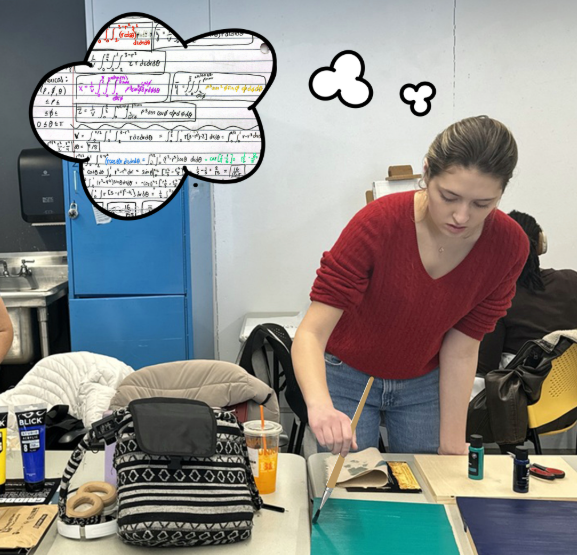
Now, as an engineering major, my artistic background has heavily influenced my passion for design and ideation. Art shows up in many ways, from the sketches in my multivariable calculus notebook to the whiteboard drawings of wearable device designs.
This intersection between STEM and art is closely tied to McCormick’s school motto, “Whole-Brain Engineering,” which encourages students to explore their creative side. The left brain encompasses logical and analytical traits, whereas the right brain focuses on creative and intuitive approaches. Whole-Brain stresses the importance of students utilizing both. By creating a multidisciplinary environment, it allows for individuals – like myself – to be immersed in a robust and unique class of like-minded engineers.
“I’ve always believed engineers are the best artists,” said McCormick second-year Dana Balin.
While studying computer science, Balin uses art as a pathway to explore her ideas and express her creativity.
Her love for art stemmed from a creative aunt inspiring her to illustrate, and her parents encouraging her to explore all her varying interests.
“I draw a lot in my free time,” Balin said. “I have two sketchbooks. One where I draw things I want to build and then one where I draw for fun.”
McCormick and School of Communication second-year Paeytn Naidoo said Northwestern’s culture and application process curate this interdisciplinary environment for engineers.
Naidoo is pursuing a dual degree in mechanical engineering and Radio/Television/Video/Film.
“Being a dual degree gives me the space to balance engineering courses with courses that are more on the artistic side with creative expression,” Naidoo said. “There are so few programs in the country that allow you to study engineering with something else, especially art.”
Naidoo said having the space to pursue another field encourages engineers to lean into their creative tendencies more, whether in classes or during their free time.
McCormick second-year Selene Sun said her artistic journey began at a young age with interests in a wide variety of artistic mediums. Sun is pursuing a major in materials science engineering and a minor in art history.
“Writing about art was actually interesting for me,” Sun said. “I feel like I can say a lot about the compositions, why we put this here, saturation, color theory. I have all of these in the back of my pocket.”
Sun initially transferred into McCormick from Weinberg because she was intrigued by the Design Thinking Communication (DTC) courses. This class requires students to engage in illustration classes to expand their artistic skills for design.
Sun noticed that half of the students in her Introduction to Sculpture class “were from McCormick.” She said it was interesting to see the different ways students of different majors would problem-solve.
For example, a fellow student studying computer science took a different approach than Sun did. Her pieces were more free-spirited with less planning. “I started with all the dimensions and drew it out,” Sun said.
The problem-solving process can initially seem very different for engineers and artists, but the processes are very similar, both involving a creative approach.
“For an artist to express themselves fully, they are going through the process of, ‘I want to achieve this effect. What is the physical technique or approach?’” Sun said. “Engineering takes the approach of, ‘What performance do we want, and what property does that imply? What kind of structure and processing can we do to achieve such forms?’ There is a similarity.”
Despite these similarities, McCormick second-year John Eckman said he found it difficult to incorporate art into his life outside of classes.
Eckman is majoring in materials science engineering. He said that the time-consuming course load of an engineering student makes it difficult to “have the energy to embrace art.”
In high school, Eckman found an escape from academics in musical theater. He spoke about the creative freedom being part of that community can bring.
“You get to put yourself outside of school, not worry about any of that, just focus on the characters, the story, the songs,” Eckman said.
Eckman has found ways to be creative in engineering through the problem-solving curriculum of DTC.
In the DTC courses, professors will have students work in teams as they navigate several distinct creative processes such as ideation and construction. DTC has allowed him to think creatively when it comes to “puzzling out ideas.”
“It is very theoretical,” Eckman said. Professors often encourage students to think outside of the laws of physics and what is possible to develop solutions to their assigned problems.
While both Eckman and Balin discussed the challenge of pursuing the arts outside of the McCormick course load, they enjoy that their introduction to engineering at Northwestern was through the creativity of DTC.
“There are very few engineers I’ve met who don’t have an artistic background,” Balin said. “Just because you can’t study both at the same time, I don’t think that discounts doing it as a hobby. I think it’s a rhetoric we were raised on, but I don’t see the proof in real life.”
Artistic experience heavily influences how engineers solve problems. These two subjects, often treated as separate disciplines, can be integral to how we design, iterate and communicate. While Northwestern engineers may lack time, they do not lack creativity.
Finding it difficult to incorporate art during my time as an engineer has left me feeling devoid of aspects of my identity that I’ve held for so long. However, noticing that art is not just about the physical paintings we create or the illustrations we sketch has allowed me to be more open to creative processes in engineering. For engineers, that same creativity, whether or not it’s expressed as physical media, still translates into the work we design and curate.
Whether an engineer thinks they are artistic or not, art is one of the many skills engineers possess that will continue to drive ingenuity.
As Naidoo said, “Engineering is all about designing and innovation, but art is all about conveying your ideas. Your design is only as good as you can describe it.”