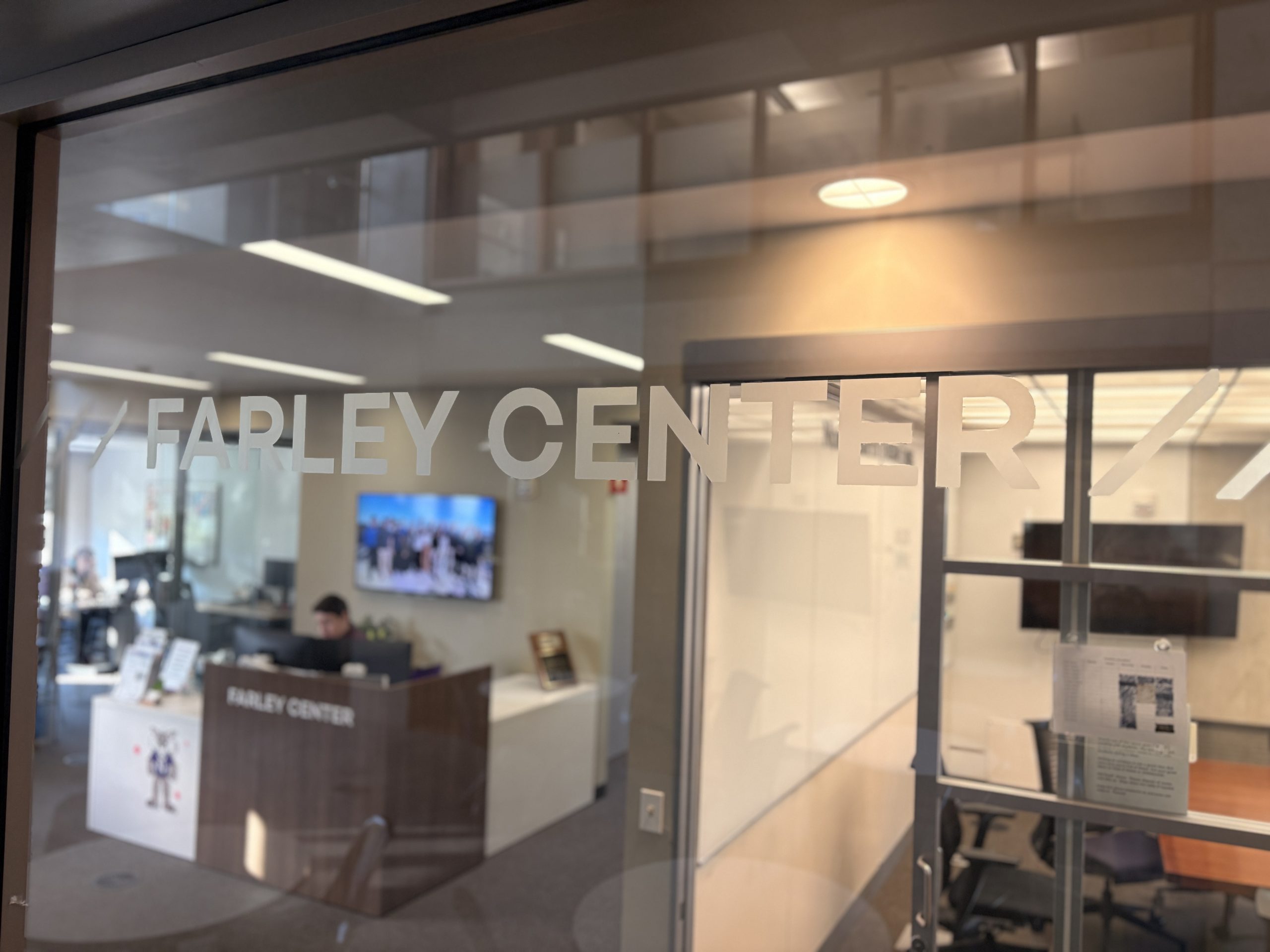
At Northwestern’s Farley Center for Entrepreneurship and Innovation, students and faculty are looking to the future. At the forefront of thought, technology, business and leadership, one ability shows the most value: “human skills,” said Hayes Ferguson, the Farley Center’s endowed director and McCormick clinical professor.
Demand is growing among both students and employers for skills like flexibility, working on a team and communication, she said. The center’s curriculum provides experiential opportunities for students to develop these abilities with like-minded innovators.
The NUvention program includes a series of courses that pull students from across different majors, schools and degrees to solve a problem as a team of entrepreneurs. The center also includes entrepreneurial courses covering leadership, finance and more.
Ferguson said Farley’s experiential learning opportunities strengthen students’ human skills and enable the faculty to provide “cutting-edge education in entrepreneurship.”
The rise of artificial intelligence (AI) has accelerated the need for human skills, Ferguson said.
“AI can do an awful lot, as we know, and it has an increasing amount of knowledge, but you still need people who can figure out what knowledge they want to seek from AI,” Ferguson said. “They need to be able to get along with other people or provide leadership.”
Simon Rhode, a Farley student ambassador and second-year Master’s student in McCormick’s engineering design innovation program, is in his second NUvention class. His team at NUvention Energy is creating a theoretical startup to recycle electric vehicle batteries. He said working with people in other fields opens up new perspectives and ways to solve problems.
“When we all sat down in a group and talked about that kind of stuff, it was really hard,” Rhode said. “It took us a couple weeks to actually figure out how to do that, but at the same time, the tools and the way that the other people think in these different fields were super cool and really gave a lot of depth and understanding.”
This emphasis on cross-disciplinary collaboration goes beyond traditional entrepreneurs. Anne Libera, the director of comedy studies at The Second City, a Chicago-based improv troupe, teaches another class — The Agile Pitch.
“Improv is honestly a great skill for anyone in the entrepreneurial field to have,” said Katie Chang, Farley associate director.
McCormick Clinical Professor, Eduardo Acuna, who teaches NUvention Medical among other Farley courses, said the key to succeeding at the center comes from showing curiosity, particularly with NUvention classes’ many guest lecturers.
“If you asked [a guest], instead of just saying, ‘Hello,’ or being polite, you said, ‘Who are you? What do you do? What’s your story?’ you’d walk away that day enriched and possibly inspired,” Acuna said. “To really succeed in the Farley Center, you just need to ask.”
The Farley Center Advisory Board, a team of entrepreneurs appointed by the dean of McCormick, is in discussions with Ferguson about how to strengthen and multiply these connections through curiosity.
The center’s student ambassadors proposed one idea to increase opportunities for students to network with Farley alumni, including members of the board.
“There are definitely ideas or desires to engage alumni more, to do more matchmaking between students looking for jobs and alums,” Ferguson said. “There’s a fair amount of that that goes on now, but can we scale it? Can we do better?”
With their insight on many different domains, the board assists Ferguson with her top priority for Farley: finding a fresh perspective on entrepreneurship education.
“They really understand what’s needed in terms of skills,” Ferguson said. “and what I’m hearing increasingly is the need for these human skills.”